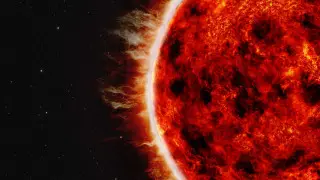
When stars explode, it's a messy business. But the massive blasts are also useful, seeding the universe with such key elements as calcium, iron and titanium.
Japan's new solid-fuel rocket blasted off Saturday carrying a telescope for remote observation of planets in a launch coordinated from a laptop computer-based command centre.
Australia took a major step towards the ambitious Square Kilometre Array (SKA) astronomy project with the switching on Tuesday of a test telescope to explore the origins of the universe.
In a super-arid desert at an altitude of 5,000 meters, with almost no humidity or vegetation, the world's largest ground-based astronomy project opens for business Wednesday ready to probe the universe with unprecedented might.
Astronomers using a powerful telescope in southern Chile have captured the first direct image of a protoplanet forming around another star, still embedded in thick gas and dust.
Telescopes at a global astronomy research hub appear to have survived a devastating Australian bushfire that destroyed nearby homes and damaged several buildings on the site.
The Hubble Space Telescope is giving scientists a look at the oldest galaxies ever seen, dating back some 13.3 billion years -- providing a glimpse into how the cosmos must have looked right after the Big Bang.
Astronomers using a powerful Chile-based telescope on Wednesday released a rare image of a spiral shell of cosmic dust and gas surrounding a red giant star.
The huge "Cherenkov" telescope, the size of two lawn tennis courts and the biggest of its kind, has started to capture cosmic rays from its base in Namibia.