
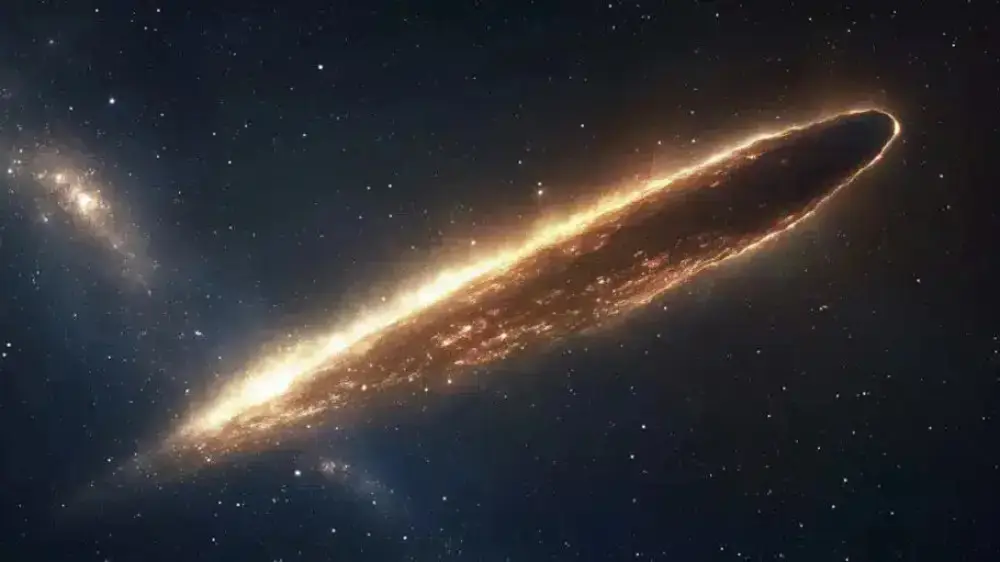
Tengrinews.kz – Astronomers have discovered that the interstellar comet 3I/ATLAS contains a record-high amount of “heavy water.” This indicates that the object formed under conditions very different from those in which the Solar System emerged. The study was published in the journal Nature Astronomy, citing Gazeta.Ru.
Comet 3I/ATLAS was discovered less than a year ago and became the third confirmed interstellar object observed in the Solar System. Scientists from the University of Michigan studied the composition of water in its gas envelope and found an unusually high concentration of deuterium, a heavy isotope of hydrogen.
Ordinary water consists of two hydrogen atoms and one oxygen atom. However, in “heavy water,” some of the hydrogen is replaced by deuterium, which contains not only a proton but also a neutron.
Researchers found that the ratio of deuterium to ordinary hydrogen in 3I/ATLAS is about 30 times higher than in Solar System comets and almost 40 times higher than in Earth’s oceans.
“The amount of deuterium relative to ordinary hydrogen in the water turned out to be higher than anything we have ever seen in other planetary systems and comets,” said the study’s lead author, Luis Salazar Manzano.
According to scientists, deuterium content serves as a kind of chemical fingerprint, making it possible to understand the conditions under which an object formed. A high share of heavy water suggests that the comet originated in an extremely cold region with a low level of radiation.
“This is evidence that the conditions that led to the formation of our Solar System are not universal across the galaxy,” said study co-author Teresa Paneque-Carreno.
For the analysis, the scientists used data from the MDM Observatory in Arizona and the ALMA radio telescope complex in Chile. ALMA’s instruments made it possible, for the first time in history, to directly measure the heavy-water content of an interstellar object.
Scientists believe that the number of similar discoveries will increase in the coming years thanks to new telescopes. This will help compare the conditions under which planetary systems form in different parts of the galaxy.

