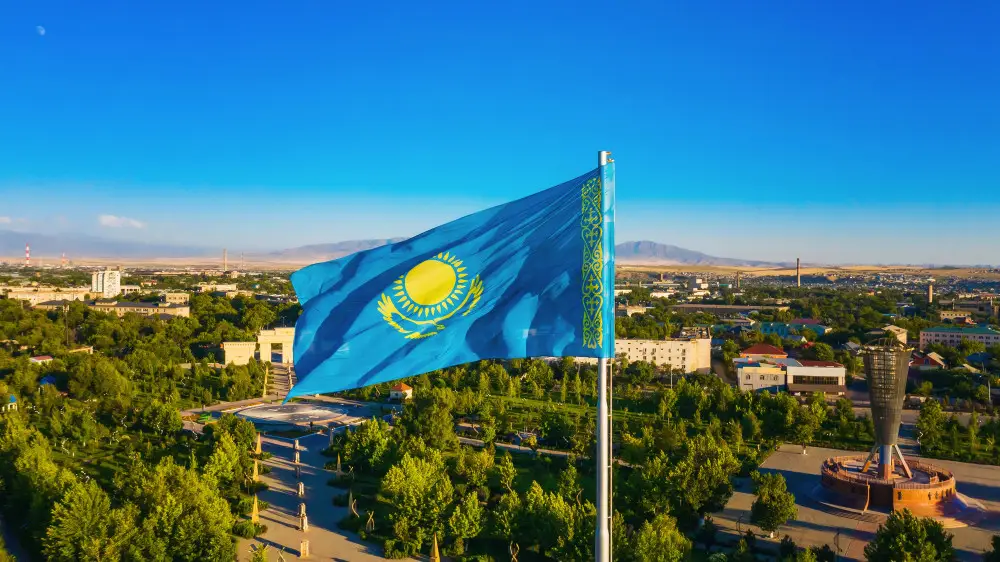
Tengrinews.kz — Social media users abroad have "discovered" Kazakhstan, sparking a heated debate over the anthropology of its people. The discussion escalated after a viral post suggested the country should become a global hub for so-called "wasians". Tengrinews.kz reached out to renowned geneticist Maksat Zhabagin to understand why this popular English-language slang has no bearing on the Kazakh people.
What are "wasians" and how is TikTok involved?
The term "wasian" (a portmanteau of "white" and "Asian") emerged on the English-speaking internet in the 2010s. It typically refers to an individual with one parent of European descent and one of Asian descent.
The term saw a resurgence in popularity thanks to the TikTok trend #WasianCheck, where users shared their mixed heritage and posted photos of their parents.
@nikokatsuyoshi So I made my own sound for all the wasians out there :) #sdg #fyp #wasiancheck ♬ Wasian Check... but different - Niko Katsuyoshi
@leagabriella mixed🤞🏻 #fyp #foryou #wasian #mixed #viral #serbia #taiwan ♬ Mix challenge - Markie Lucas
Later, a viral post on X introduced a provocative idea: the author suggested Kazakhstan could serve as a sort of "wasian homeland," noting that many of the country's residents share physical features with people of mixed European and Asian roots.
With the world population of Wasians growing, will Kazakhstan become the Wasian Israel? A place Wasians everywhere in search of an identity can call their ancestral homeland, young Wasians in the west becoming ‘Kazakh-boos’ and taking their birthright trips to the Kazakh steppe? https://t.co/368MSxHsZl pic.twitter.com/CDwBOy14uV
— ɖʀʊӄքǟ ӄʊռʟɛʏ 🇧🇹🇹🇩 (@kunley_drukpa) May 4, 2026
The post triggered a backlash. While some supported the idea, others pointed out that Central Asian peoples have a distinct historical formation that cannot be reduced to modern internet slang.
- "No, please, anything but this. Central Asian peoples are not 'wasians'; we have our own history. Furthermore, we descend from Amur and Baikal-type Asians and Iranian steppe nomads."
- "Being wasian is so funny: your dad looks one way, your mom looks another, but you end up looking like neither and just turn out looking Kazakh."
- "But... aren't Kazakhs... essentially the original wasians?"
- "White people discovered Kazakhstan, and now they're mass-reposting one tweet and calling us wasians. I hope we don't end up with too many of them here."
- "I think all wasians just have to visit Kazakhstan. You will be surprised that everyone there look wasian".
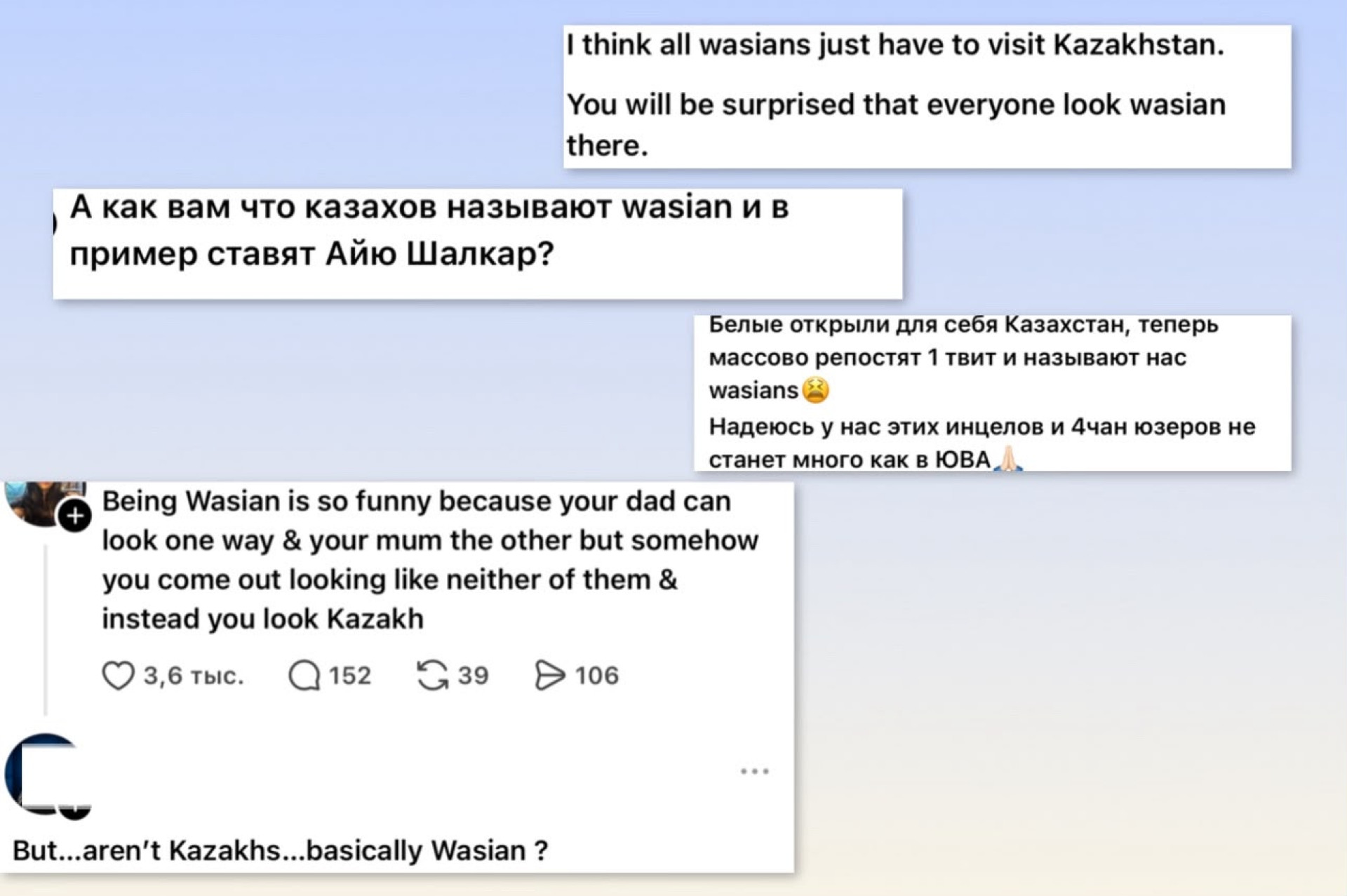 Screenshot: Threads
What science says
According to geneticist Maksat Zhabagin, the term "wasian" has no scientific basis.
"Wasian is internet slang derived from 'white' and 'Asian.' It usually refers to individuals of first-generation mixed European and Asian descent. This term is not used in scientific genetics. Geneticists don't speak of 'wasians'; they refer to the ratio of West Eurasian and East Eurasian ancestral components," Zhabagin explained.
Kazakhs cannot be categorized by this term because the nation's gene pool was formed over many generations, whereas the slang term refers to individuals whose immediate parents belong to different races.
"The word 'wasian' emerged in Anglophone mass culture to describe someone with one European parent and one East Asian parent. It is incorrect to apply this to Kazakhs, as we are not talking about individual mixed parentage, but about a population shaped by historical processes spanning thousands of years," the geneticist noted.
The origin of European features in Kazakhs
The scientist emphasizes that modern genetic research does show both West Eurasian and East Eurasian components in the Kazakh genome.
From an anthropological perspective, Kazakhs are traditionally classified as the South Siberian type, which occupies an intermediate position between the Caucasoid and Mongoloid populations of Eurasia.
However, this is not the result of recent mixing.
"In physical anthropology, Kazakhs are traditionally assigned to the South Siberian anthropological type, an intermediate link between Eurasian Caucasoid and Mongoloid populations. Modern genetic studies largely confirm these observations, showing that the Kazakh genome contains both West Eurasian and East Eurasian ancestral components," Zhabagin explained.
However, it is more accurate to refer to these as "West Eurasian" rather than "European" components.
"The Kazakh genome was formed from several ancient layers: Bronze Age steppe pastoralists, Saka and Sarmatian groups, Central Asian agricultural populations, and East Eurasian nomads from Altai, Southern Siberia, and Mongolia," the geneticist shared.
Why Kazakhs can look different
According to the scientist, the physical appearance of Kazakhs can vary significantly because each individual carries a different genetic heritage. This extends to the point where even biological siblings can look completely different from one another.
"Kazakhs carry varying proportions of West Eurasian and East Eurasian heritage. In one person, traits associated with the West Eurasian layer may be more pronounced, while in another, the East Eurasian traits prevail. Many genes are responsible for appearance, and even close relatives can look different," the geneticist noted.
The genetic portrait of these peoples was shaped across several eras.
"First, there were ancient local and steppe populations, followed by the Bronze Age, the Saka-Scythian world, Turkic migrations, the Xiongnu, medieval nomadic empires, and the era of the Mongol Empire. The modern Kazakh gene pool is the result of the multilayered history of the Great Steppe," he shared.
Where Kazakhs sit on the genetic map of Eurasia
According to the scientist, Kazakhs indeed occupy a unique place on the genetic map of Eurasia.
"Kazakhs are located almost at the center of the Eurasian genetic continuum between West and East. But importantly: this is not a chaotic mixture, but a historically established profile of a steppe population where various components have merged over millennia," he explained.
According to Zhabagin, while there is no single "genetic code" for Kazakhs in the colloquial sense, there is a unique portrait: a weaving together of steppe, Central Asian, and East Asian roots.
He added that, according to genome-wide studies, Kazakhs are closest to other peoples of the region—Nogais, Karakalpaks, Kyrgyz, and partially to Uzbeks and Uyghurs, as well as the peoples of Southern Siberia and Mongolia.