


 Қазақша
 Русский
 English

ПОДЕЛИТЬСЯ
- Main
- Yesterday 23:14
Scientists have calculated when the end of the world will occur
 depositphotos.com
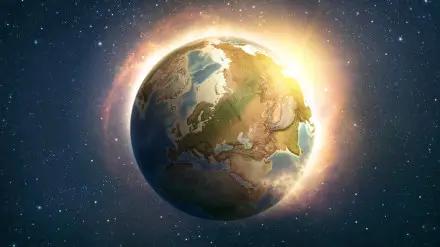
Tengrinews.kz — Scientists have calculated the potential lifespan of life on Earth, concluding that the planet's plant biosphere could survive for approximately another 1.8 billion years. The Daily Mail reports this, citing study results relayed by Daily Mail citing the results of the study.
In the study, specialists from the University of Colorado Boulder and the Seattle-based company Blue Marble Space utilized a three-dimensional climate model that accounted for changes in temperature, cloud cover, precipitation, ocean states, and atmospheric circulation. The scientists simulated the evolution of Earth's climate over the next two billion years.
The authors of the paper believe that as the Sun ages, its luminosity will gradually increase. Consequently, temperatures on Earth will continue to rise, while the concentration of carbon dioxide—essential for plant photosynthesis—will decline. Ultimately, this will lead to the extinction of most vegetation. Only the most drought-resistant species, including cacti and plants utilizing specialized types of photosynthesis, are expected to survive the longest.
The scientists examined two scenarios: a gradual decrease in carbon dioxide concentration due to absorption by rocks (certain rock types can absorb carbon dioxide through a process known as natural weathering or mineral carbonation) and a variant where carbon levels remain relatively constant, with rising temperatures serving as the primary factor.
Calculations showed that Earth's plant biosphere is capable of existing for about 1.8 billion years. This is significantly longer than suggested in several previous studies. After this period, Earth is expected to begin losing its oceans and become uninhabitable due to the further increase in the Sun's luminosity.
However, the authors emphasized that the simulation did not account for the possible evolution of plants or potential technological advancements by humanity. According to the scientists, these factors could alter the lifespan of the biosphere.
The researchers did not rule out the possibility that plants could theoretically adapt to new conditions, or that life could migrate into the upper atmosphere or even beyond Earth. Furthermore, scientists are already considering various methods for artificially reducing solar radiation, although the consequences of such technologies remain insufficiently understood.
Editorial Question
What’s your take on this news?
Comments are moderated by the editorial team
Show comments


 +7 (777) 001 44 99


