
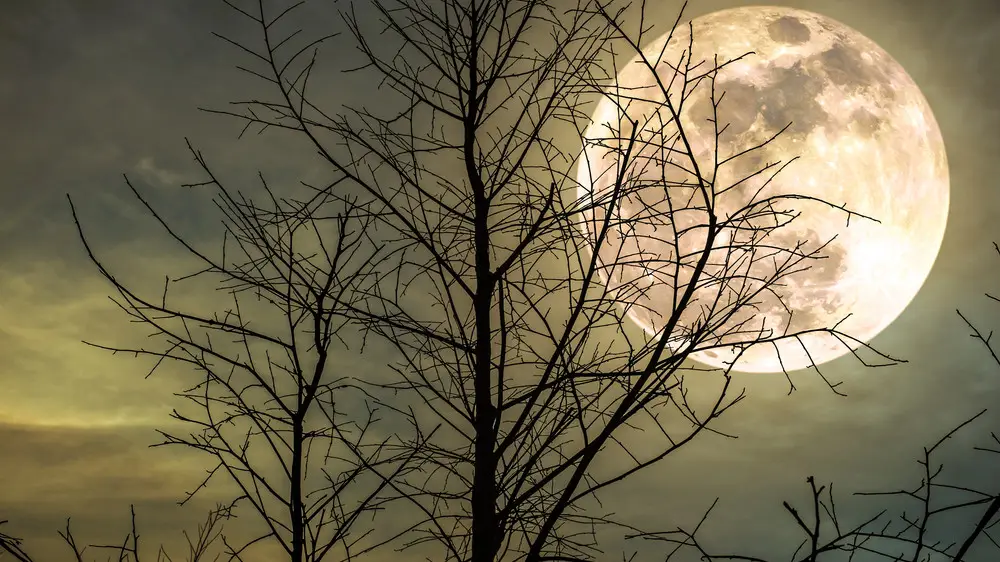
Tengrinews.kz – On the night of December 4–5, 2025, residents of Kazakhstan will be able to observe the final supermoon of the year — the Cold Moon. On this night, Earth’s natural satellite will come closest to our planet and appear larger and brighter than usual.
According to astronomers, the December supermoon can be observed starting at midnight, with the peak occurring at 04:14 Astana time.
In fact, the full and bright Moon will be visible for three nights in a row — from December 4 to 6. The December full moon is traditionally called the Cold Moon, a name associated with the arrival of frosty weather and the longest nights in the Northern Hemisphere.
For observers across the Northern Hemisphere, this supermoon will be especially spectacular. According to astronomers, this full moon will be higher in the sky than any other upcoming full moon until 2042. At its closest point to Earth, the Moon will appear about 8 percent larger and 15 percent brighter than during a typical full moon.
How a supermoon forms
The Moon’s orbit around Earth is not a perfect circle but an ellipse. Because of this, the distance between the two celestial bodies is constantly changing.
At perigee, the Moon comes closest to Earth (approximately 356,000–360,000 km).
At apogee, the farthest point, it moves away to 405,000–406,000 km.
When a full moon occurs at or near perigee, we observe a supermoon. At this moment, the lunar disk can appear 10–15 percent larger and 20–30 percent brighter than a full moon at apogee (known as a micromoon).
The supermoon cycle repeats roughly every 413 days. Three to four such events can occur each year. The supermoon on December 5, 2025, will be the final one in this cycle.

