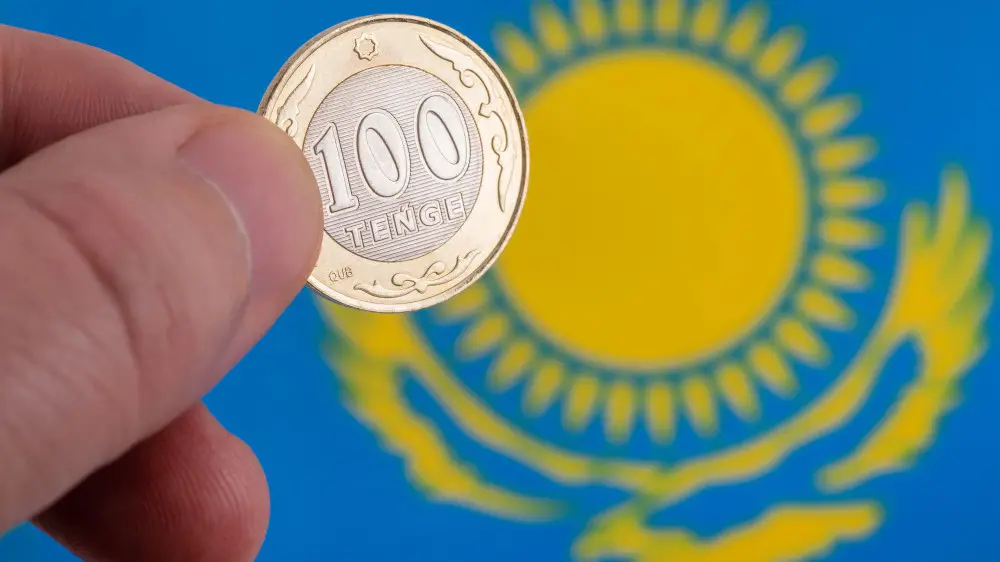
Tengrinews.kz – Starting July 1, 2026, the spelling “теңге (teŋge)” must be used in Kazakhstan’s official legal sphere. This follows from responses by the Ministry of Justice and the National Bank to official inquiries from the Tengrinews.kz editorial office.
However, the main everyday question remains open: how should everyone else now write the name of the national currency — in the media, textbooks, advertising, price tags, contracts of private companies, banking apps and ordinary correspondence?
What changes from July 1
In the Russian-language text of the new Constitution, Kazakhstan’s national currency is written as “теңге.” The new Constitution comes into force on July 1, 2026.
The Ministry of Justice explained that after this date, the terminology enshrined in the Constitution must be used in the official legal sphere. This means that state bodies, when preparing regulatory legal acts and other official documents, must follow the new spelling.
The ministry also said that government agencies are already working to bring regulatory legal acts into line with the Constitution. This will be done in stages.
Why everyone started talking about “теңге”
One of the first notable amendments concerns the Tax Code. Tengrinews.kz has already reported that from July 1, the spelling “тенге (tenge)” will be replaced with “теңге (teŋge)” in the document. In other words, in the official Russian-language text of the code, the name of the national currency will be written with the Kazakh letter “ң (ŋ).”
This is not a monetary reform, a currency replacement or a change in its status. It is a terminological amendment related to bringing legislation into line with the new constitutional model.
The same package of amendments to the Tax Code also changes other wording. For example, the word “foreigner” is being replaced with “foreign citizen,” references to Parliament in a number of provisions are being replaced with Kurultai, and the phrase “republican referendum” is being replaced with “nationwide referendum.” Some articles will include the wording “Kurultai of the Republic of Kazakhstan” and “Kazakhstan Halyk Kenesi,” while in lists of territories, the capital will be mentioned first, followed by regions and cities of republican significance.
In other words, replacing “тенге” with “теңге” is part of a broader legal adjustment of legislation following the constitutional changes.
Old contracts do not need to be revised
The Ministry of Justice separately emphasized that documents in which the spelling “тенге” was previously used do not lose their legal force. This applies to previously adopted regulatory legal acts, contracts and other documents.
“Previously adopted regulatory legal acts, contracts and other documents containing the spelling ‘тенге’ retain their legal force and do not require revision solely due to the change in the spelling of the name of the national currency,” the ministry said.
The new spelling “теңге” must be used in regulatory legal acts adopted after July 1, as well as when amendments are made to existing legislation.
What will happen in banks
The National Bank also said it is preparing amendments to its regulatory legal acts on payments and payment systems. In particular, this concerns payment document forms, which are planned to be brought into line with the new spelling of the national currency’s name.
According to the National Bank, the draft has already been approved by the regulator’s relevant departments, the Association of Financiers of Kazakhstan and second-tier banks. Work on its adoption is now continuing.
At the same time, the National Bank emphasized that the changes are editorial in nature and do not alter the operation of payment systems, money transfers or payment infrastructure.
The National Bank’s press service also told Tengrinews.kz that the regulator itself will now use the spelling “теңге” in its statements and press releases.
But how should everyone else write it
There is less clarity on this for now. The responses from the Ministry of Justice and the National Bank indicate that for state bodies and the official legal sphere, the spelling “теңге” becomes the reference point. However, no direct requirement has yet been announced for citizens, media outlets, private companies, shops, advertisers, publishers or educational institutions.
For example, it is still not fully clear how Russian-language media outlets, schools and universities in textbooks, private companies in contracts and invoices, stores on price tags and receipts, banks in apps and statements, as well as online platforms and marketplaces should write the name of the currency after July 1.
There is also no unified public clarification yet on whether the variant “тенге” should be considered outdated, non-standard or orthographically incorrect in ordinary Russian-language text.
These are the questions that the Tengrinews.kz editorial office sent to the Ministry of Science and Higher Education. They include which spelling is recommended for Russian-language media, whether the letter “ң” is acceptable inside Russian-language text, whether phrases such as “in теңге,” “теңге exchange rate” and “one million теңге” should be used, and whether the new spelling is planned to be included in dictionaries and official recommendations.
The Ministry of Science and Higher Education has not yet provided a substantive response and has taken additional time to prepare one.