
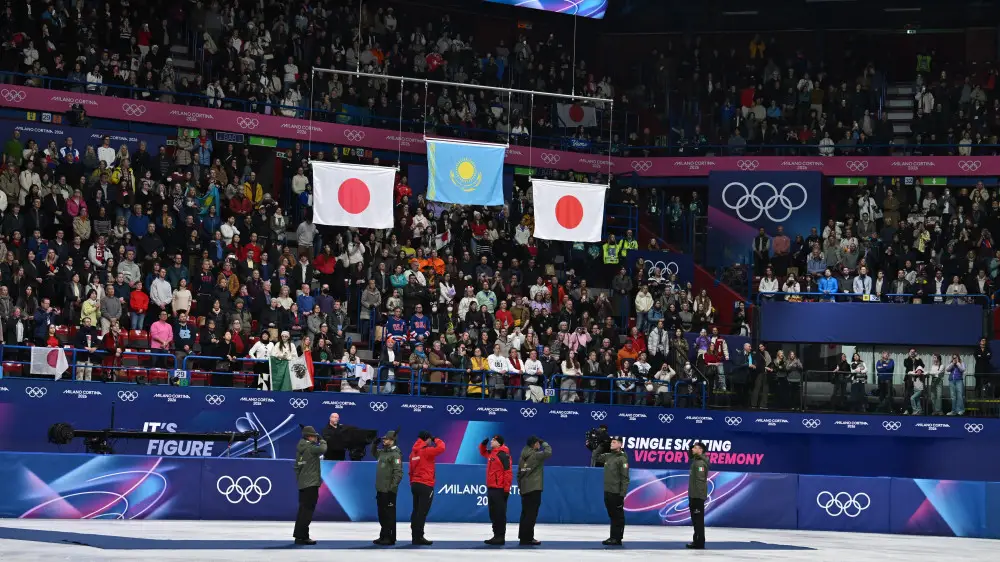
Tengrinews.kz – Allegations have surfaced in the media and on social networks accusing Kazakh figure skating judge Nadezhda Paretskaya of bias during the Olympic Games. The National Olympic Committee of Kazakhstan has responded to claims regarding her scoring.
What are the accusations?
The main criticism centers on allegedly inflated scores given to Russian skater Adelia Petrosyan in both the short program and free skate.
However, a closer look at the detailed judging sheets shows that all nine judges demonstrated variations in scoring, reflecting the subjective nature of figure skating evaluation.
For example, in the short program, Paretskaya awarded Sofya Samodelkina 70.5 points, while a British judge gave her only 64.1.
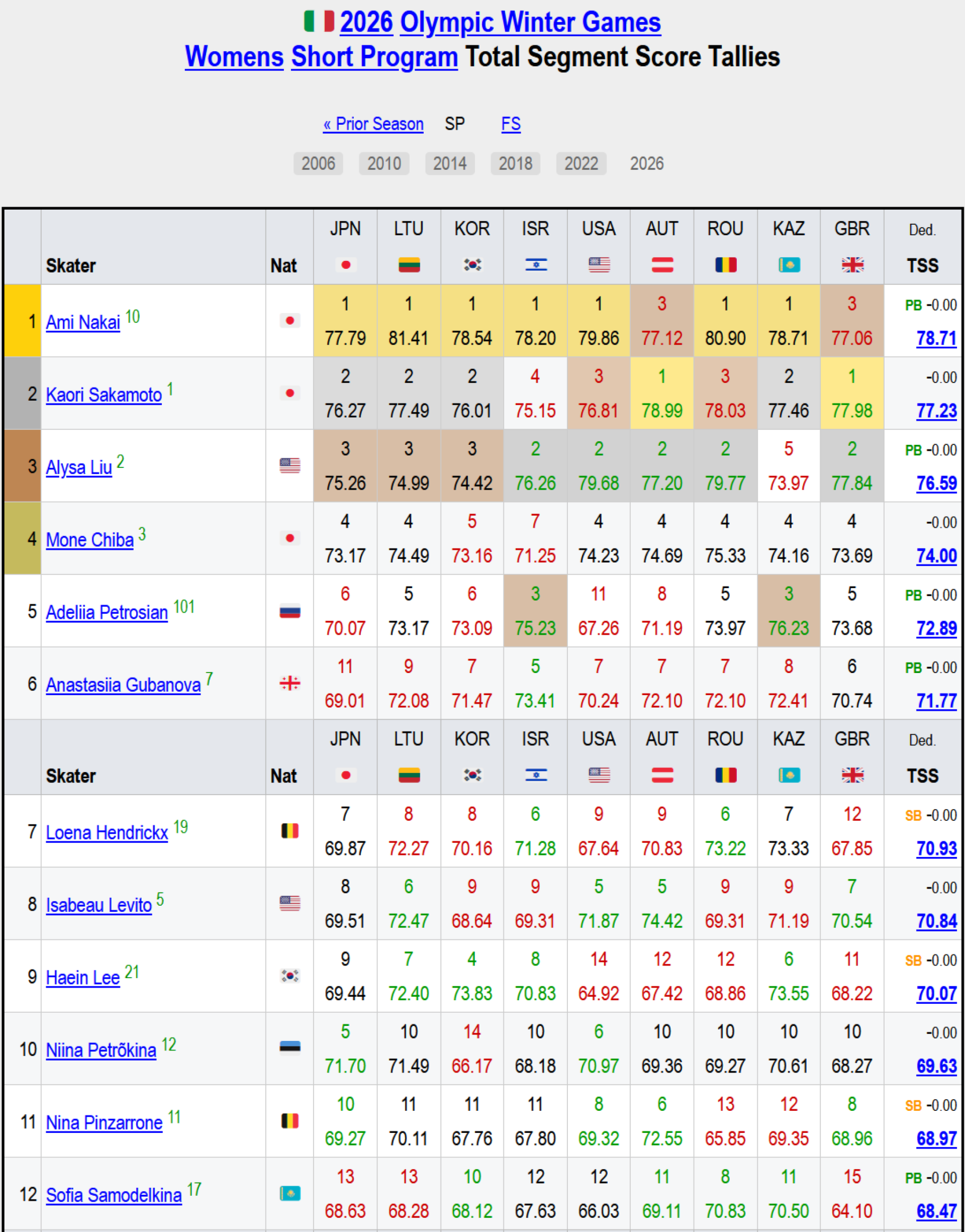 Photo: Detailed scoring breakdown for the short program / ISU
At the same time, Paretskaya scored Petrosyan’s short program at 76.23 — higher than any other judge on the panel. In the free skate, she ranked Petrosyan first with 147.04 points, while giving Alysa Liu of the United States — who ultimately won gold — nine points fewer than the judge who awarded Liu the highest score.
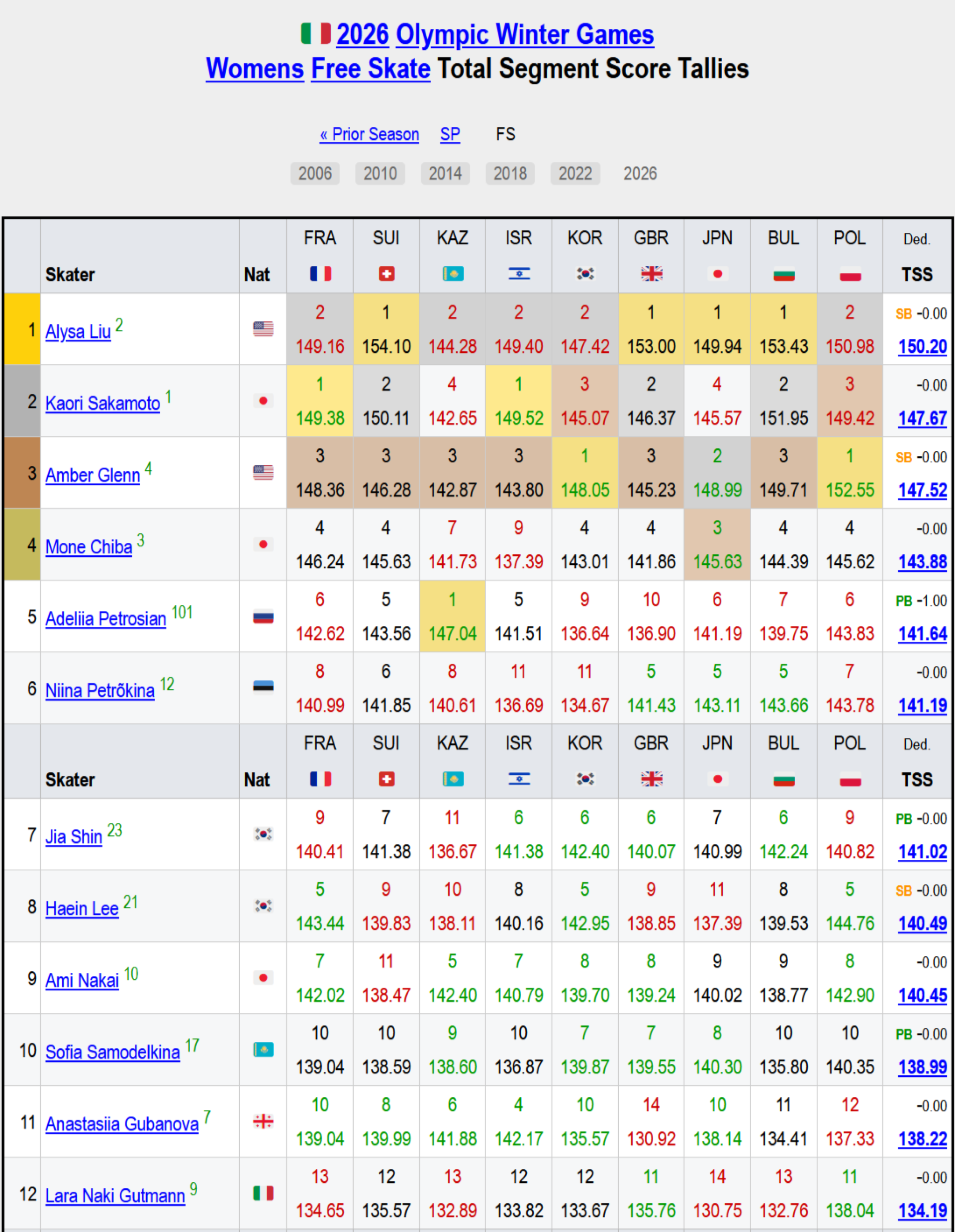 Photo: Detailed scoring breakdown for the short program / ISU
A similar situation was observed in the men’s event, where Paretskaya was accused of giving higher scores to Russian skater Petr Gumennik. According to her scores, Gumennik placed second in the free skate behind Kazakhstan’s Mikhail Shaidorov, whereas other judges ranked him fourth.
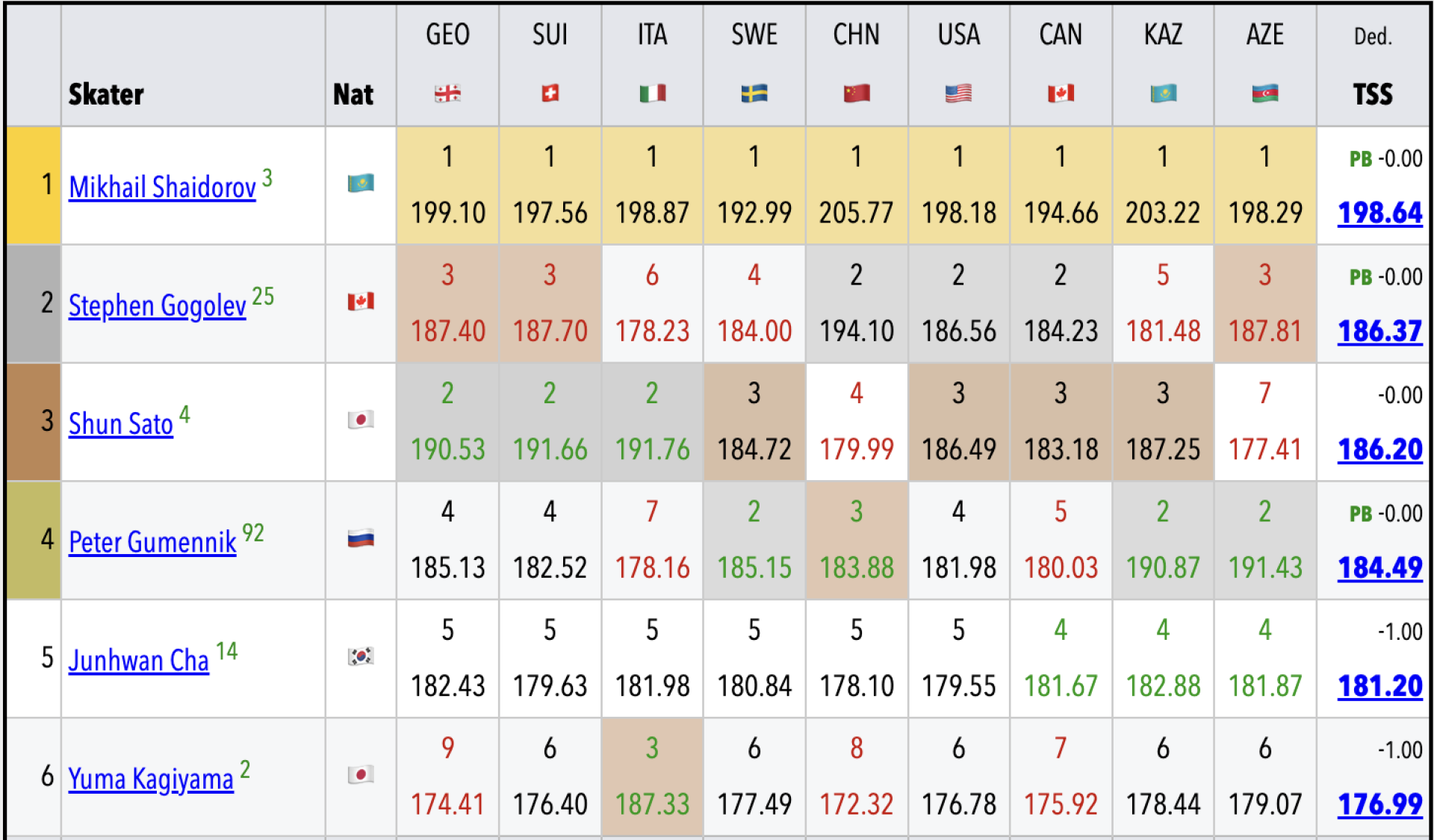 Photo: Detailed scoring breakdown for the free skate / ISU
At the same time, analysis of the full judging breakdown shows that nearly every judge had athletes who received comparatively higher marks from them than from others.
For instance, in the men’s free skate, the difference between the highest and lowest score for Japan’s Yuma Kagiyama exceeded 13 points. In the women’s competition, Anastasia Gubanova received 130 points from a British judge and 142 from an Israeli judge.
Shaidorov, in his gold medal-winning free skate, received his highest score — 205.77 points — from a Chinese judge, seven points above his overall average.
Judge declines to comment
Tengrinews.kz contacted Nadezhda Paretskaya for comment. She stated that the ISU Code of Ethics prohibits judges from commenting on competitions they officiate.
“Under the ISU Code of Ethics, I am not allowed to comment on tournaments where I have judged. For all questions, please contact the Kazakhstan Figure Skating Union,” Paretskaya said.
The Kazakhstan Figure Skating Union also declined to comment on specific scores but emphasized that the Kazakh representative met all international requirements.
The National Olympic Committee of Kazakhstan stressed that it has no role in appointing judges to the Olympic Games.
“Appointment of judges to the Olympic Games does not fall under the competence of the NOC of Kazakhstan. These functions are entirely within the authority of international sports federations.
In figure skating, this responsibility lies with the International Skating Union (ISU), which independently determines the list of specialists authorized to officiate at the Olympic Games. National Olympic Committees do not influence this process,” the statement said.
Judges at the Olympics serve as independent technical specialists operating strictly under ISU rules, with oversight by ISU technical committees.
ISU response
According to Forbes, which published one of the most detailed accusations against Paretskaya, the ISU did not comment on the specific judge but addressed the general scoring system.
“In response to an inquiry, an ISU spokesperson stated that "it is normal for there to be a range of scores" and that "the highest and lowest scores for each element are typically dropped" to mitigate outliers.
While the ISU did not comment on Judge Paretskaia specifically, the organization noted that an Officials’ Assessment Committee (OAC) evaluates performances to "ensure the integrity and quality" of competitions. The ISU concluded that it has "full confidence in the scores given" and remains committed to fairness,” the publication reported.
The same article also noted alleged scoring bias from American judge Kevin Rosenstein, whose scores for Petrosyan were seven points below the average, and for Samodelkina two points below the average.
Final results
Kazakhstan delivered its best figure skating performance in Olympic history in Italy. Mikhail Shaidorov became the first Kazakh skater to win Olympic gold, while Sofya Samodelkina finished in the top 10.
Despite variations in individual scores, the overall results in both the men’s and women’s singles events have largely been viewed as fair. Shaidorov’s and Liu’s victories have not been widely disputed, while lower placements for Russian skaters Petrosyan and Gumennik were attributed to performance errors and lower combined scores.

