
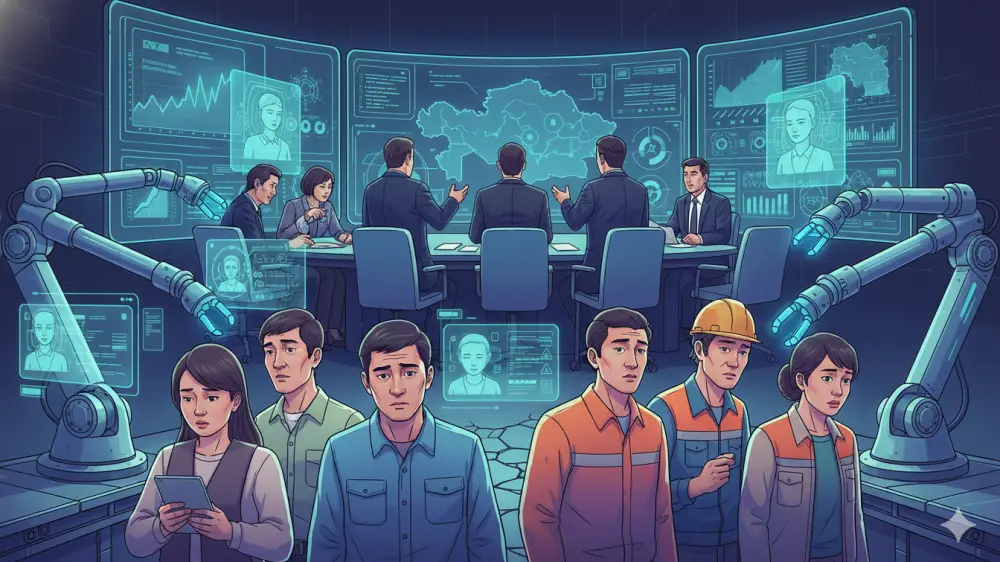
Tengrinews.kz – Up to one million Kazakhstani workers could lose their jobs due to the rise of artificial intelligence (AI) and automation by 2030, according to Deputy Minister of Artificial Intelligence and Digital Development Dmitry Moon.
He outlined how the government is preparing to counter this challenge.
According to Moon, the Ministry of Labor and Social Protection has projected that 2.5 million specialists may face automation risks within the next five years, and about one million of them could be directly replaced by AI technologies.
“We’ve spoken with the vice minister — around one million specialists could be replaced because of AI adoption. That’s why we’re taking proactive measures,” Moon said.
Government retraining plan
The official announced a nationwide retraining initiative designed to help citizens adapt to the changing job market.
“We have a plan through 2029 to retrain one million citizens. On the Astana Hub platform, free video courses are already available — with lessons from tutors, coaches, and experts, including in AI-related fields,” he explained.
Among new priority professions are data annotators, specialists who prepare datasets for training AI models — one of the fastest-growing digital roles worldwide.
Focus on automation-resistant skills
Government agencies are currently identifying which job functions can be safely automated and which should remain human-driven.
“AI performs well in certain routine tasks. But humans typically handle a broader set of responsibilities. Yes, some repetitive functions can be automated to ease workloads, but there are no exact predictions yet on who might be replaced,” Moon noted.
He confirmed that AI could also optimize government operations, gradually reducing bureaucracy and improving efficiency.
“Of course, AI will automate more and more processes and may indirectly contribute to streamlining the public sector,” he added.
New opportunities from AI
Despite the risks, Moon emphasized that AI — much like the internet revolution — will not only displace jobs but also create new ones.
“One profession that will remain in demand is programming. Programmers aren’t afraid of AI — they use it to boost productivity. If a developer used to build a website in two weeks, now they can do it in a single day with AI tools,” he concluded.

