
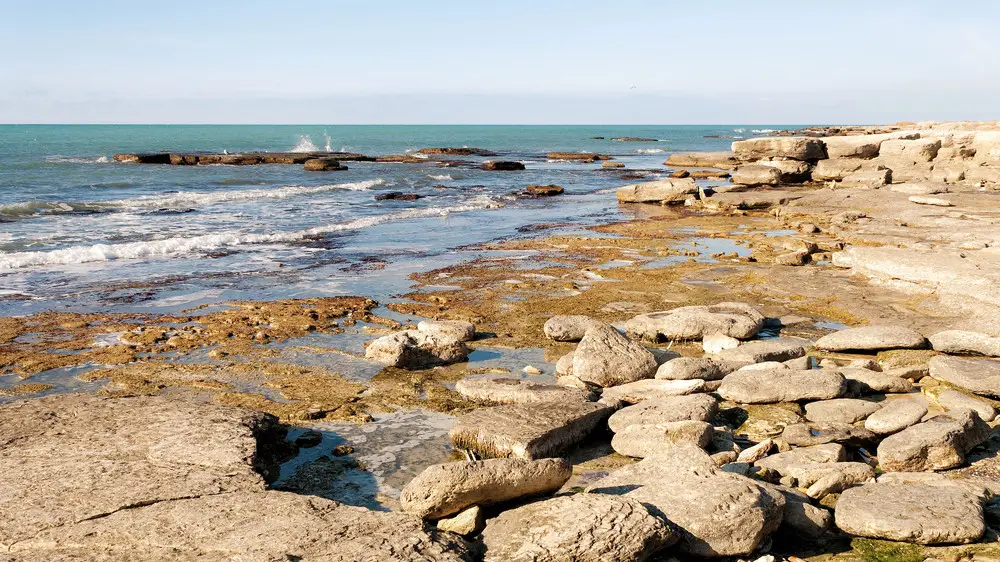
Tengrinews.kz – Preventing the decline in the Caspian Sea level is very difficult because it is a natural phenomenon linked to global and regional climate change, Russian oceanologist Vladimir Shevchenko told RIA Novosti.
According to scientists, the drop in the Caspian Sea’s water level is expected to continue for at least the next 25–50 years.
“Preventing the decline is difficult. It is largely a natural phenomenon associated with global and regional climate change, which has led to a sharp increase in evaporation from the sea's surface. Even slightly slowing the drop in sea level is also difficult. While the Volga River’s flow has indeed decreased in recent years, we cannot consider it the main cause of the shallowing,” the expert said.
He emphasized that it is more accurate to speak of a decline in sea level, rather than shallowing, since over the past 30 years the level has dropped by three meters, while the maximum depth is 1,015 meters.
The scientist also noted that predicting a fate similar to the Aral Sea for the Caspian is entirely incorrect.
“The Aral Sea is the opposite example, as it was truly destroyed by human activity — although climate factors also played a role, increasing evaporation and reducing precipitation in the river basins. However, the water body has already been partially restored by building a dam between the Northern (Small) Aral and the Southern (Large) Aral,” said Shevchenko.
According to him, the population of 22 fish species has already been restored in the Small Aral, and further rehabilitation of these bodies of water is possible by increasing the flow of the Amu Darya and Syr Darya rivers, whose waters are currently used for irrigating agricultural lands.
Earlier, the head of Rosvodresursy, Dmitry Kirillov, also stated that the shallowing of the Caspian Sea is a result of climate change and is not related to the regulation of water flow in the Volga River.

