
Tengrinews.kz – Almaty is located in a seismic hazard zone, which makes it especially important for the earthquake early-warning system to function without failures. Why it did not activate in January 2024, and how Automated Early Warning Systems (AEWS) differs from Mass Alert — Tengrinews.kz examined the details.
High seismicity of the region
According to the Ministry of Emergency Situations (MES), the Almaty akimat and the regional emergency department are implementing an automated early-warning system for strong earthquakes. It includes two components: the Early Warning System (AEWS) and the Mass Alert instant notification system.
The need for early warning arises from the region’s high seismic risk.
“The early-warning system is a modern observation complex in which all processes — from recording and transmitting data to analyzing it and issuing a warning signal — are carried out automatically,” MES explained.
According to the ministry, the full cycle of data processing and signal transmission takes 2–3 seconds, allowing the system to warn people before strong seismic waves arrive.
“The operator’s role is limited to monitoring and supervision, since such reaction speed is impossible manually,” the MES stated.
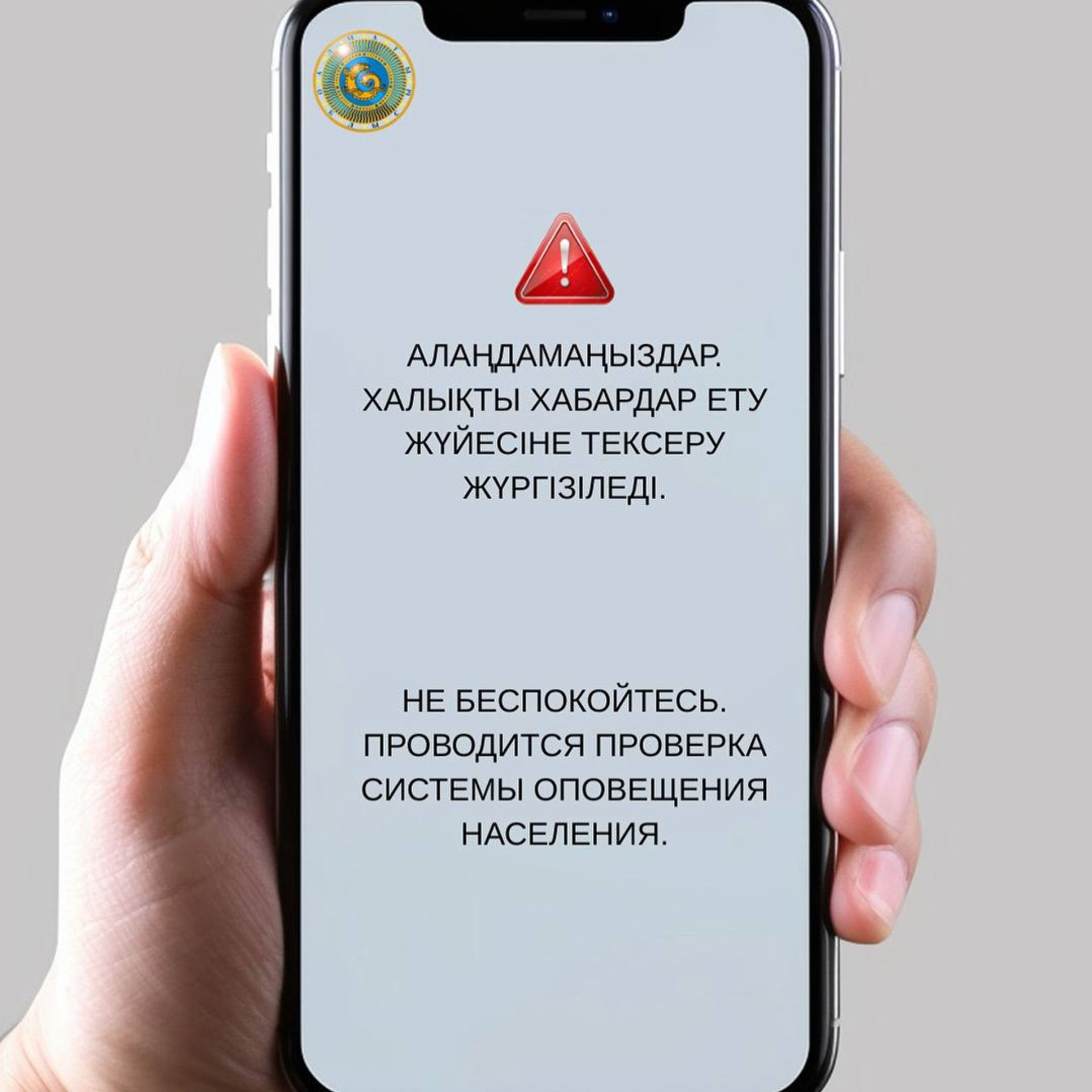 Photo: MES
AEWS
AEWS consists of 28 seismic stations located throughout the Almaty seismic test area. The system automatically detects the approach of destructive seismic waves and sends an advance signal to warn the population, including through Mass Alert. According to MES, all stations are currently operational.
Mass Alert
Mass Alert is an emergency push-notification system that instantly warns all mobile subscribers located within the coverage area of cell-tower antennas using Cell Broadcast technology.
“Mass Alert processes more than 60,000 base-station sectors across Almaty and the suburbs from three mobile operators within 1 minute,” MES reported.
By comparison, SMS delivery can take 1 to 24 hours. The system covers 90–97% of mobile base stations. Mass Alert can also send alerts to specific map zones and is used for various types of emergency situations.
“If three or more AEWS sensors register seismic activity, a warning is automatically sent to Mass Alert about the approaching earthquake. After that, the alert is activated automatically,” MES clarified.
 Generated using AI
Why the systems did not activate in January 2024
According to MES, during the January 2024 earthquake in Almaty, AEWS was operating in test mode, while Mass Alert was still under development. Therefore, the systems were not yet integrated.
“AEWS had only recently been commissioned and, following international practice, was in a test phase. Mass Alert, as of January 2024, was still being developed. At that time, the two systems were not integrated,” MES stated.
Why the system activated on October 23, 2025
On October 23, Almaty residents received earthquake notifications — some believed they were a “false alarm.”
MES explained that the message was automatically generated and correct.
During the earthquakes on September 21 and October 23, AEWS detected real tremors and automatically triggered Mass Alert. Earthquakes were not felt in Almaty because the epicenters were distant.
The system is now undergoing additional calibration based on accumulated seismic data and regional conditions.
“In both cases, tremors were not felt in Almaty due to the epicenters’ distance. The equipment is currently being fine-tuned considering the region’s geological and soil characteristics,” MES added.
Based on real seismic events, specialists are adjusting system parameters for Almaty. The MES noted that the algorithms are being continuously improved.
“The system has confirmed its operability, responding exclusively to real seismic events,” they emphasized.
Future development
MES stressed that the current AEWS network of 28 stations is only the first stage of creating a full citywide early-warning network. The number of stations will be expanded to include surrounding districts.
A key future objective is automated protective actions, such as stopping trains, shutting off gas and electricity. According to MES, this will: “minimize the consequences of strong earthquakes and improve the safety of the population and critical infrastructure.”

