
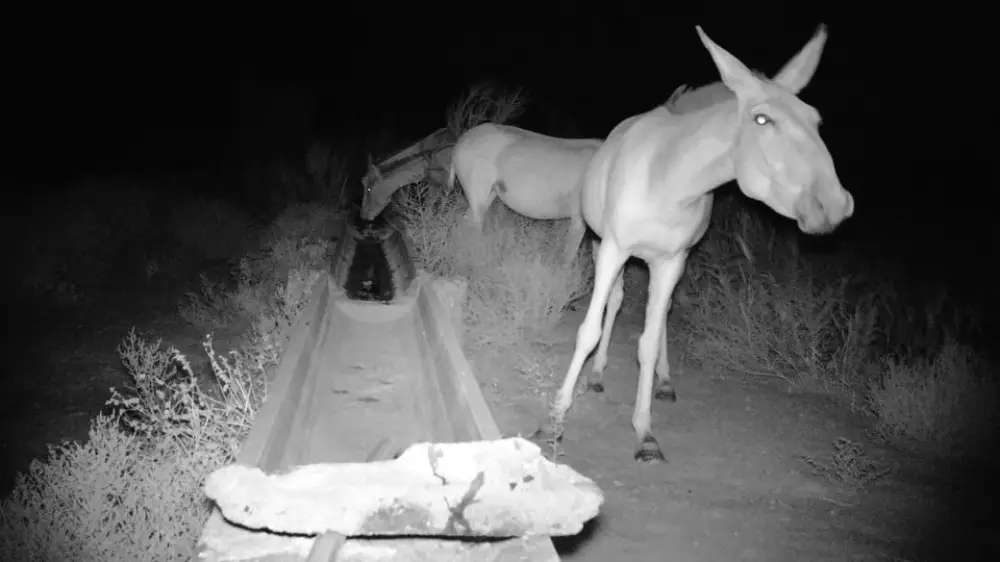
Tengrinews.kz – Cameras have captured rare animals in the Ile-Balkhash State Nature Reserve.
The photos were shared on the reserve’s official Instagram account. The images show a small group of kulan (wild asses) drinking from an artificial water source. The camera trap recorded the moment on July 21.
The post notes that the kulan is rarely seen in the wild and may face extinction.
“The kulan is an animal on the brink of extinction! In Kazakhstan, it is listed in the Red Book (Category II), included in the IUCN Red List, and Appendix II of the CITES Convention,” the publication states.
Where the red-listed kulan lives
The reserve explained the primary habitat of this rare and fast animal:
“It inhabits desert and semi-desert areas, and is known for its endurance and speed. Since it depends on water sources, it often gathers near rivers, lakes, and wells,” they said.
What are kulan and why are they unique?
Tengrinews contacted the Ile-Balkhash Reserve to learn more about this remarkable wild horse. It turns out the animal captured in the photo is a Turkmen kulan.
“Currently, scientists recognize five subspecies of kulan: Mongolian kulan, Gobi kulan, Indian kulan, Turkmen kulan, and onager,” noted the reserve.
Посмотреть эту публикацию в Instagram
They added that in the past, the Kazakhstani subspecies of kulan lived in the steppes and deserts of Kazakhstan, but by the beginning of the 20th century, it had completely disappeared.
Where do kulan live today?
According to the reserve, the restoration of Turkmen kulan populations began in 1953. Today, they can be found in five protected areas of Kazakhstan:
- Barsakelmes Nature Reserve;
- Altyn-Emel National Park;
- Betpak-Dala;
- Ile-Balkhash Reserve;
- Altyn Dala.
An attempt to populate the Aktau-Buzachinsky reserve was unsuccessful.
How many kulan are left in Kazakhstan?
According to the Ile-Balkhash Nature Reserve, there are currently 94 Turkmen kulans living in its territory.
Their populations can be found not only in Kazakhstan, but also in Turkmenistan, Uzbekistan, and even Ukraine, where they have also been reintroduced.

