
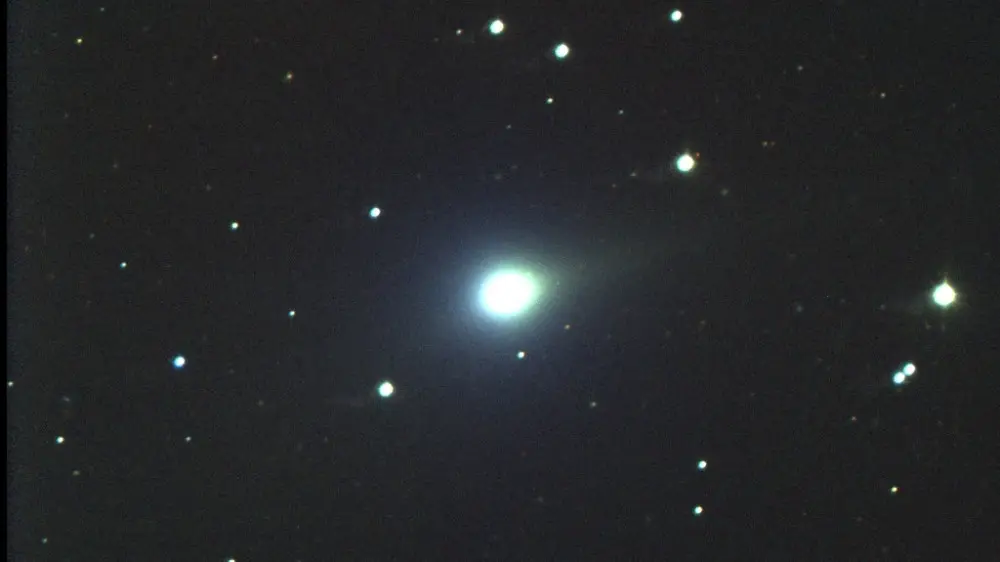
Tengrinews.kz – Kazakhstanis have a chance to see the well-known comet 3I/ATLAS. Expert Maksim Krugov explained how this can be done.
“You need to know where to look”
According to the specialist, seeing the comet with the naked eye is practically impossible. At present, its brightness is about tenth magnitude, whereas the limit of human vision is roughly sixth magnitude. Simply put, the human eye can no longer perceive such brightness, even in complete darkness.
“The human eye can distinguish objects down to about sixth magnitude, while here it’s tenth. Imagine this: each magnitude differs in brightness by about 2.5 times – that’s 2.5 multiplied by 2.5, multiplied by 2.5, and again by 2.5. This is already beyond normal vision even on a perfectly dark night, let alone outside mountainous areas,” said Maksim Krugov, senior research fellow at the Fesenkov Astrophysical Institute.
At the same time, observation is still possible using simple optical tools, such as binoculars, but for this it is necessary to know exactly where to look in the sky.
“We observe it from about three in the morning until sunrise – it’s located in the east. Visually, it doesn’t look like anything special; it’s just an ordinary, unremarkable ‘little star.’ In theory, you can see it through binoculars, but it’s better to use, for example, a camera. With a long exposure, you can capture it and even record its movement. There are websites that publish comet ephemerides (special astronomical tables with the coordinates of celestial bodies – ed.) – you can roughly aim and take some shots. It can actually be quite interesting,” Krugov explained.
“Go outside the city”
However, it is important to keep in mind that such observations require leaving the city. As the expert reminded, observatories are located far from populated areas and sources of light pollution, usually in mountainous regions.
“This is necessary to see a truly dark sky. It provides much better conditions for observations. This is exactly what distinguishes the Assy-Turgen Observatory: there is no light pollution here because there are no sources of artificial light. In addition, the atmosphere contains virtually no dust that causes scattering. The altitude is almost 3,000 meters above sea level, so there is no haze that usually accumulates below and interferes with observations,” noted Maksim Krugov.
Comet 3I/ATLAS
Maksim Krugov clarified that the object was designated 3I/ATLAS, where the “3I” index indicates that it is the third confirmed interstellar object recorded passing through the Solar System.
According to him, the comet was discovered thanks to a combination of several factors at once: highly accurate algorithms, the favorable location of the observatory in Chile, and the winter season with longer nights.
The comet 3I/ATLAS was discovered on July 1, 2025, using the automated ATLAS telescope.
“The ATLAS telescope is a very powerful project that combines a high-quality wide-field instrument (about 50 centimeters) with a strong computing infrastructure and advanced data-processing algorithms. It is ATLAS that has registered many new objects,” Krugov explained earlier.
Kazakh scientists began attempts to observe the comet back in July, but clear images were obtained only at the end of November.
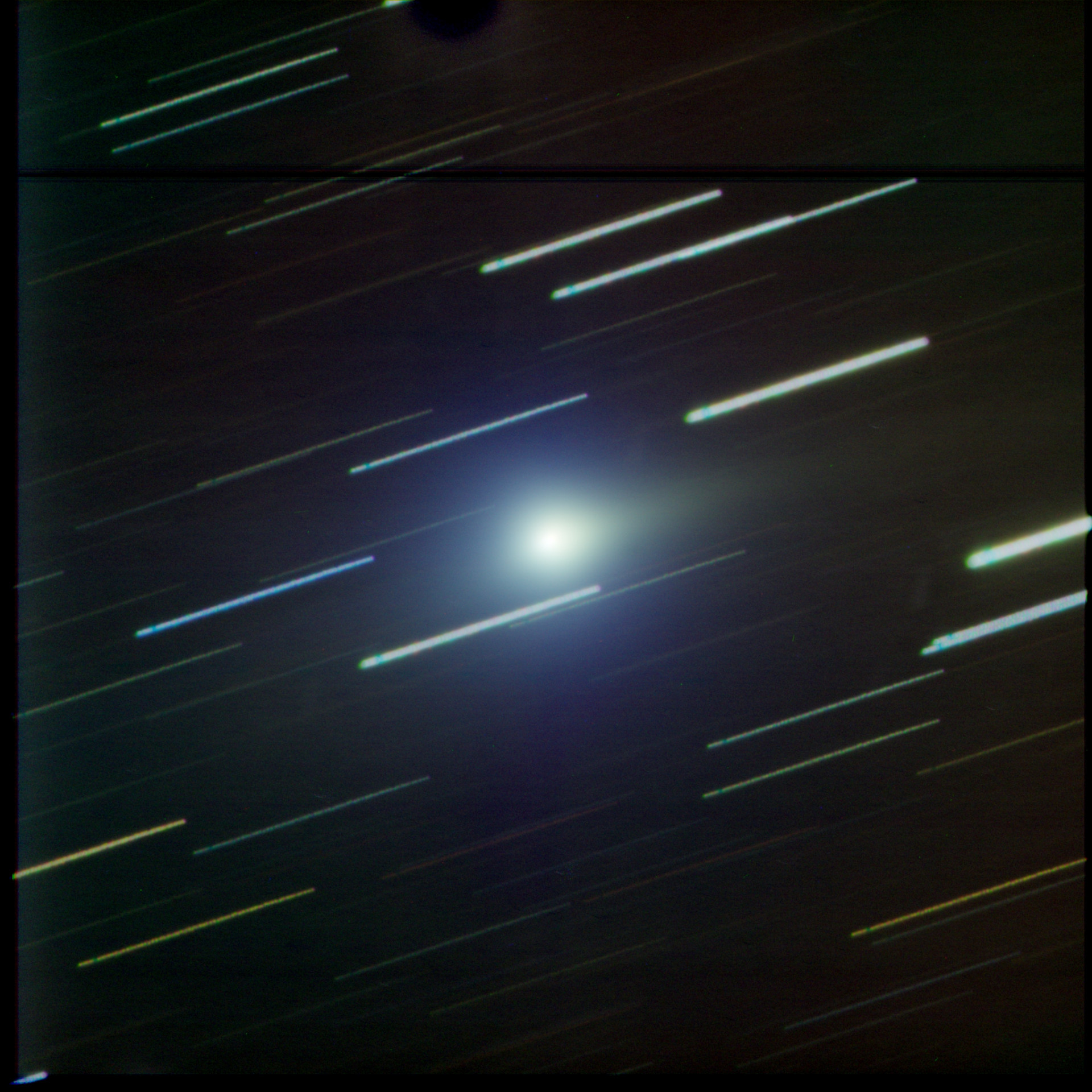 Image of the comet captured by Kazakhstani astrophysicists
Krugov recalled that studies of 3I/ATLAS are ongoing and will continue at least until March.
“It is still too early to draw final conclusions, as observations are still being accumulated. According to preliminary estimates, its age may range from 7 to 14 billion years, meaning it formed even before the emergence of our Solar System, likely in a long-disintegrated planetary system,” said Maksim Krugov.
The scientist emphasized that 3I/ATLAS is definitely a comet.
“Frankly, I do not agree with the formulations that are now being actively promoted about some kind of alien origin. Of course not. It is an ordinary comet,” he added.
According to calculations previously reported in the media, the minimum distance between the Earth and the comet is expected on December 19.
Earlier, we also spoke with Lyubov Shestakova, head of the Laboratory of Stellar and Nebular Physics at the Fesenkov Astrophysical Institute. She refuted claims circulating on social media that comet 3I/ATLAS could be an artificial object and urged people not to trust such theories.

