


 Қазақша
 Русский
 English

ПОДЕЛИТЬСЯ
- Main
- 15 July 2026 10:18
Kazakhstanis to witness several space phenomena at once in late July
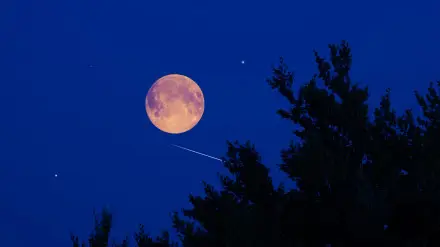 Photo:depositphotos.com
Tengrinews.kz — At the end of July, Kazakhstanis will witness several astronomical events at once: the July full moon, known as the Buck Moon, the peak of two meteor showers, and the appearance of Comet 10P/Tempel 2. However, not all of these phenomena will be visible in full. Tengrinews.kz asked the Fesenkov Astrophysical Institute what stargazing enthusiasts can expect.
When the Buck Moon can be seen
The July full moon is traditionally called the Buck Moon. This name comes from the Indigenous peoples of North America: at this time, young male deer begin to grow new antlers. In different countries, this full moon is also known as the Thunder Moon or Hay Moon.
According to specialists from the Fesenkov Astrophysical Institute, in Kazakhstan the full Moon will reach its maximum phase on July 29 at 7:35 p.m. Astana time.
Double meteor shower: will it be visible in Kazakhstan?
On the night of July 30 to 31, two meteor showers are expected to peak at once — the Southern Delta Aquariids and the Alpha Capricornids. Usually, this is one of the most beautiful astronomical events of the second half of summer: both fast meteors and bright, slow fireballs appear in the sky at the same time.
However, this year, viewing conditions will be far from ideal.
Delta Aquariid meteor shower (005 SDA)
- Activity period: from July 12 to August 23, with the peak on July 30–31.
- Where it comes from: the radiant is located in the constellation Aquarius, and the shower is associated with Comet 96P/Machholz.
- Where it is visible: the object is best observed in the Southern Hemisphere and at low northern latitudes.
According to institute specialists, the shower will be difficult to see.
“In 2026, viewing conditions are poor, as the almost full and very bright Moon will interfere with observing the shower,” the institute noted.
In addition, the Southern Delta Aquariids are best observed in the Southern Hemisphere and at low northern latitudes.
Alpha Capricornid meteor shower (001 CAP)
- Activity period: from July 3 to August 15, with the peak on July 30–31.
- Where it comes from: the radiant is in the constellation Capricornus, and the shower was formed by Comet 169P/NEAT.
- Feature: this shower is known for its slow but very large and spectacular fireballs.
Observing the Alpha Capricornids may also be spoiled by bright moonlight.
“Visibility conditions this year are also unfavorable. The shower is clearly visible in the Southern Hemisphere, while in our latitudes moonlight will make it difficult to observe,” the scientists explained.
In July, you can try to find a comet
Another event of the month is Comet 10P/Tempel 2.
It can be searched for in the evening sky after sunset throughout July. However, it will not be visible to the naked eye.
According to the Fesenkov Astrophysical Institute, on August 2, the comet will pass perihelion — the closest point to the Sun in its orbit — and on August 3, it will make its closest approach to Earth.
“The comet will pass perihelion on August 2, and its closest approach to Earth will occur on August 3, 2026, at magnitude 6.9. It can be observed in both the Southern and Northern Hemispheres only with binoculars or a telescope,” the Fesenkov Astrophysical Institute scientists said.
Editorial Question
What’s your take on this news?
Comments are moderated by the editorial team
Show comments


 +7 (777) 001 44 99


