
Tengrinews.kz — A foreign national has unexpectedly found himself at the center of a scandal after his photo was used without permission in posts about an alleged Kazakhstani man failing to pay child support. Tengrinews.kz investigated the Ministry of Internal Affairs' stance on the matter and the potential legal consequences facing the authors of such posts.
How it all began
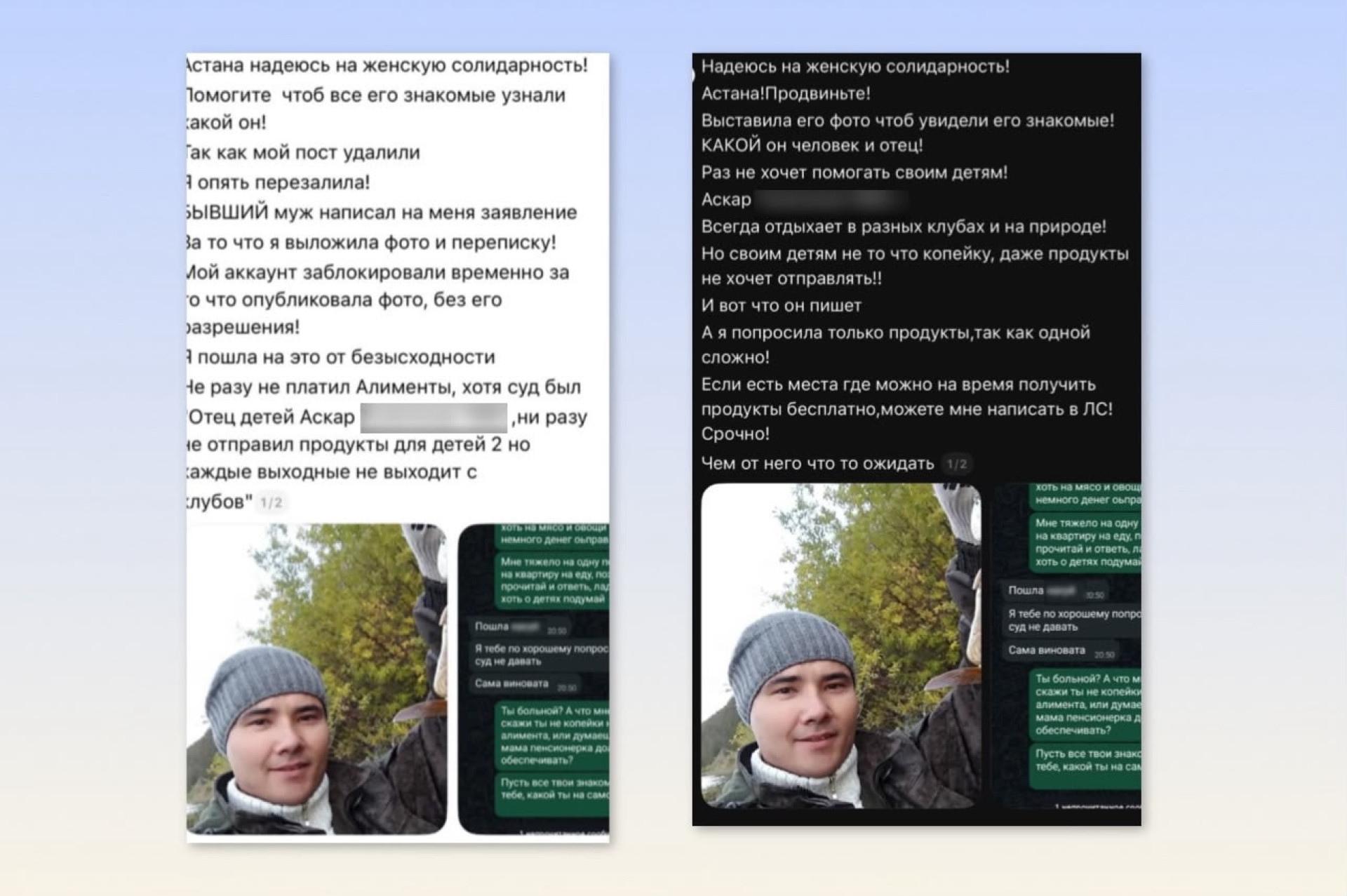
Social media posts have surfaced, presumably created by the same woman using different accounts. In them, the author accuses her ex-husband, named Askar, of evading child support payments.
In one post, the woman claims that the man leads a carefree lifestyle while failing to provide for his children.
"I posted his photo so his acquaintances could see what kind of person and father he is. He is always partying at clubs or outdoors, but he doesn't send a single penny to his own children; he even refuses to buy groceries," the author stated.
A subsequent post appeared in which the author claimed her ex-husband had filed a police report against her, and that her account had allegedly been temporarily blocked for posting photos without the man's consent.
"My ex-husband filed a report against me for posting his photo and our correspondence. My account was temporarily blocked for publishing images without his permission. I did this out of desperation. He has never paid child support, even though there is a court ruling," the author noted.
 Screenshot: Threads
The photo featured a completely different person
It later emerged that the published photos did not depict the Kazakhstani man named Askar at all.
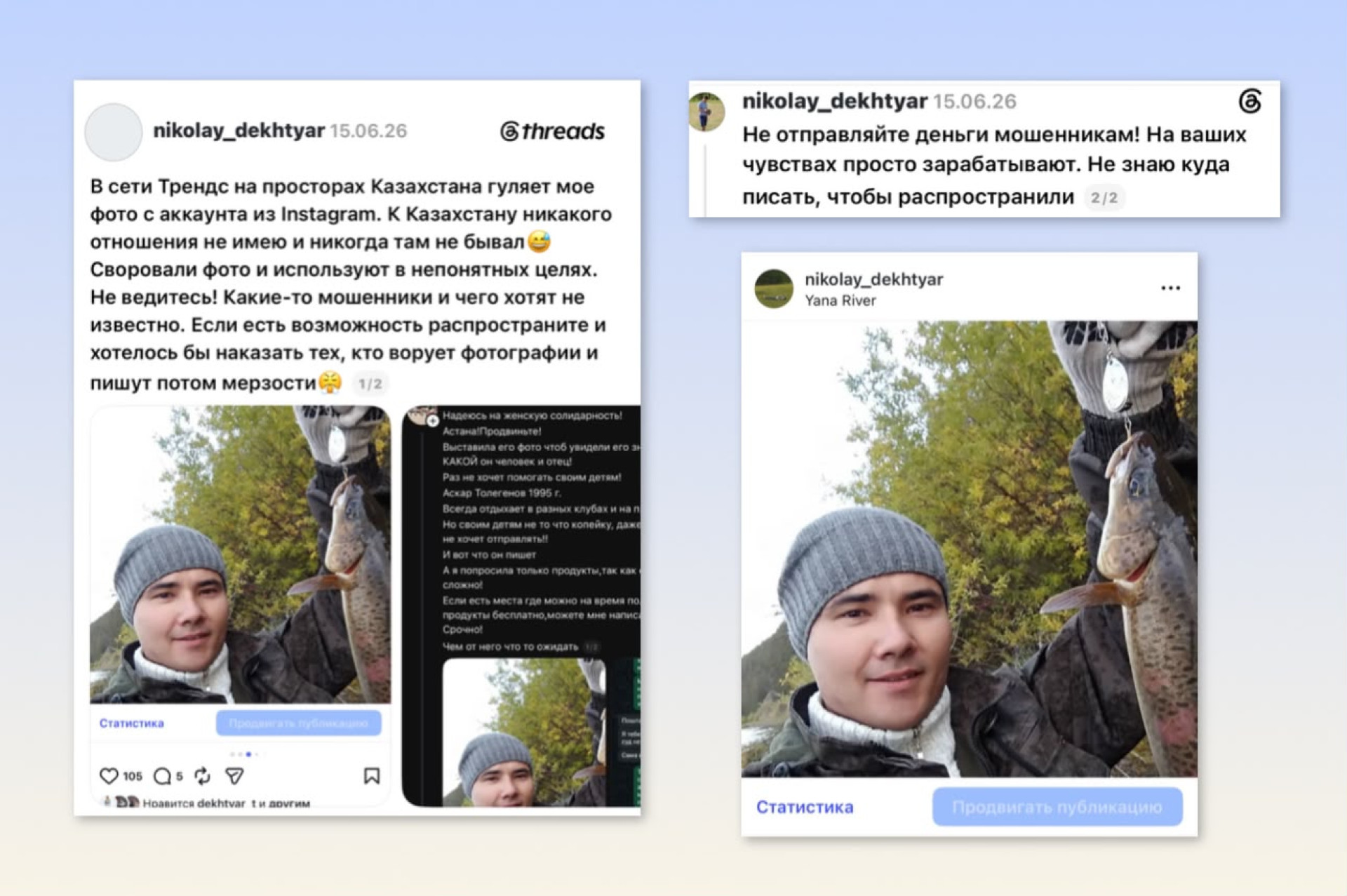
The photographs belonged to a foreign national named Nikolay, who said he discovered by chance that he had been cast as the protagonist in someone else's story.
"My photo, taken from my Instagram account, is being circulated in Kazakhstani public groups. Let me say right away: I have no connection to Kazakhstan and have never been there. My image was simply stolen and is being used for unclear purposes. Don't fall for this! Some scammers are at work, and it's unknown what they want. If possible, please spread this information. I really want to see those who steal others' photos and write nasty things under them punished," he shared.
According to him, the photo was simply taken from Instagram and used without authorization.
 Screenshot: Threads
Response from the Ministry of Internal Affairs
We reached out to the Ministry of Internal Affairs for comment. The agency reported that no complaints regarding this incident have been received yet. However, if a report is filed, the police will conduct an investigation.
"No reports regarding this fact have been filed with law enforcement agencies. In the event that a formal complaint is submitted, an investigation will be conducted in accordance with the procedure established by law, the results of which will provide a legal assessment of the actions of the individuals involved," the Ministry stated.
The Ministry also reminded that the dissemination of false information online can lead to both administrative and criminal liability.
"The dissemination of knowingly false information that creates a threat of disturbing public order or causing significant harm to the rights and legitimate interests of citizens, organizations, society, or the state is subject to criminal liability under Article 274 of the Criminal Code. The sanction of this article provides for punishment up to imprisonment. Furthermore, the dissemination of knowingly false information that defames the honor, dignity, or business reputation of a person may result in administrative liability for libel under Article 73-3 of the Code of Administrative Offenses," the agency explained.
Potential penalties
Depending on the circumstances of the publication, law enforcement may classify the authors' actions under several articles:
- Article 73-3 of the Code of Administrative Offenses — "Libel";
- Article 456-2 of the Code of Administrative Offenses — "Placement and dissemination of false information on the Internet";
- Article 274 of the Criminal Code — "Dissemination of knowingly false information."
Under the Code of Administrative Offenses, Article 73-3 for libel carries a fine of 160 MCI (692,000 tenge) or 15 days of arrest; for officials, the penalty is 550 MCI (2,378,750 tenge) or 20 days in custody.
If false information is published in the media or on social networks, the penalty increases: the fine for individuals rises to 180 MCI (778,500 tenge), and for officials to 650 MCI (2,811,250 tenge), with possible arrest terms increasing to 20 and 25 days, respectively.
Regarding Article 456-2 of the Code of Administrative Offenses for online misinformation, officials, small businesses, and NGOs face a fine of 30 MCI (129,750 tenge). For medium-sized businesses, this amount increases to 50 MCI (216,250 tenge), and for large enterprises, it is 100 MCI (432,500 tenge).
According to the Criminal Code, under Article 274 for the dissemination of fakes, the penalty includes a major fine of up to 1,000 MCI (4,325,000 tenge), community service for up to 400 hours, or restriction or deprivation of liberty for a term of up to one year.
If false information is published in the media, on social networks, or on online platforms, the penalties are more severe: the fine increases to 3,000 MRP (12,975,000 tenge), the duration of community service increases to 800 hours, and offenders can face imprisonment or restriction of liberty for up to three years.
Additionally, the Ministry of Internal Affairs noted that in certain cases, the actions of offenders may fall under other articles of the Criminal Code—such as invasion of privacy, illegal distribution of personal data, or inciting discord.