


 Қазақша
 Русский
 English

Tengrinews.kz – The Airbus A330 carrying President Kassym-Jomart Tokayev landed in Bishkek around five in the evening on Wednesday — just as the city’s daytime bustle was gradually giving way to evening calm. On November 27, a meeting of the CSTO Collective Security Council will take place here — a format where the leaders of five countries gather at one table.
It was a day that begins with ceremonies, first handshakes, informal settings, and a kind of show program that always serves only as an introduction to big politics. Tengrinews.kz was able to capture this atmosphere.
The first moments in Bishkek
Everything typical for such occasions was there at the foot of the aircraft: a carpet with an ornament instantly recognizable to Kazakhs, girls in traditional attire, and “birtugan-style” baursaks – Kyrgyz boorsoks.
And there stood the Prime Minister of Kyrgyzstan, Adylbek Kasymaliev — wearing an ak kalpak and a shapan, standing as if greeting a distant relative who had long promised to visit and finally arrived. The orchestra strengthened the atmosphere: the melody "Atameken" echoed across the platform — a tune Kazakhs recognize from the first notes.
After a long walk down the red carpet, the President of Kazakhstan was greeted by the choir of the Kyrgyz National Theatre of Opera and Ballet.
“Otan menin turagym da tiregim…” — the choir sang gently and reservedly, as if the conductor had asked them to sing “not loudly, but sincerely.” Tokayev listened attentively and made it clear: gestures like this are remembered.
The Kyrgyz Prime Minister, satisfied with a job well done, watched Tokayev’s car depart as the motorcade headed toward the Ala-Archa residence, where the evening promised to be no less rich in symbolism.
The shanyrak, the coat, and the music
As evening lights illuminated Ala-Archa, a yurt already stood on the grounds — simple, but significant. Nothing showy: just a symbol of respect preserved by nomadic peoples through centuries, with warm light glowing from the slightly open entrance. For Kazakh or Kyrgyz eyes, this detail clearly means: you are awaited as one of our own.
And just a minute later, Sadyr Zhaparov emerged from the yurt to invite Kassym-Jomart Tokayev for tea — that very gesture traditionally extended in the region to those with whom one wishes to speak informally and meaningfully.
A little later, Tajikistan’s President Emomali Rahmon joined them.
Zhaparov’s chief security officer stood frozen in tense silence at the entrance, one hand holding his coat pressed to his chest, the other on the door handle.
From the opposite side suddenly came loud voices. It was Vladimir Putin and Alexander Lukashenko with their delegations. It turned out that just 100 meters from the yurt, the presidents of Russia and Belarus were holding their tête-à-tête. Even after exiting the meeting room, Putin continued to “place commas in the air” as he spoke to Lukashenko.
My camera caught another detail: Alexander Grigoryevich was without a coat. And at that very moment he slowly focused his gaze on me.
The lack of a coat had its explanation: his conversation with Putin definitely wasn’t about the weather. Lukashenko assured the Russian leader that Minsk remained a place he could always return to “if he wished.” Then came the familiar theme of the West — an old topic, habitual for them, but that is not our subject here.
Accompanied by the President of Kyrgyzstan, both entered under the shanyrak of that yurt.
A moment later, another silent colleague stood beside Zhaparov’s guard — the one holding Vladimir Putin’s coat. He held it differently: apparently, the coat wasn’t to be creased.
Somewhere nearby were people carrying small cases — the kind whose contents are better not to imagine.
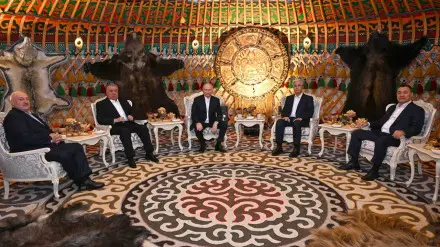
Inside the yurt, the presidents were seated in a semicircle. The seating was not in alphabetical order.
Bear and wolf pelts hung on the walls. The refreshments on the tables were arranged so neatly that for a moment it felt almost like a family toi.
Then the presidents moved on to other yurts — the ones where performers were already waiting. The interior changed from yurt to yurt: ornaments, fabrics, small details that revealed the cultural motifs of all five countries gathered in Bishkek.
For the Kazakh leader, musicians played the kyl-kyyak — a Kyrgyz bowed instrument related to the Kazakh kobyz. Kassym-Jomart Tokayev listened attentively to its sound and seemed to recognize familiar, kindred notes.
In the yurt dedicated to Russia, Putin ran his fingers across the strings of a komuz — an instrument revered here much like the dombra is in Kazakhstan. The instrument produced more of a polite sound than a melody, and Lukashenko summed it up with a smile: “It’s out of tune. Needs tuning.”
After visiting all the exhibition yurts, the presidents went on to continue their discussions.
On the way to the car, Tokayev and Putin exchanged a couple of short phrases — brief, but clearly not empty: from their expressions it was obvious that the discussion would continue. Then all five leaders took their seats in a black armored minibus.
The vehicle disappeared into the darkness, leaving behind the bear skins, ornaments, and the slightly “out-of-tune” komuz. You catch yourself thinking: nomadic diplomacy knows how to be warm, but this evening was only a prologue. The gestures of hospitality did their part, but now it was politics’ turn. The next day, under the CSTO shanyrak, each country will state its position — and Kazakhstan will have its own tone: calm, and therefore valuable and recognizable.



 +7 (777) 001 44 99


