


 Қазақша
 Русский
 English

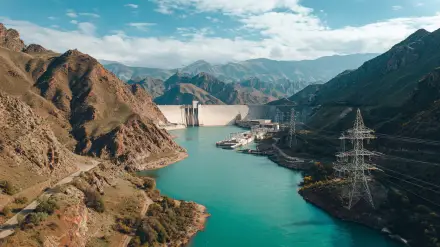
Tengrinews.kz – Kazakhstan will take on one-third of the commitments for the construction of the large Kambarata-1 Hydroelectric Power Plant in Kyrgyzstan. Tengrinews.kz explains why this project is important for Kazakhstan.
Context
In June 2024, Kazakhstan, Kyrgyzstan, and Uzbekistan agreed to jointly build the major Kambarata-1 HPP in Kyrgyzstan and signed an agreement. The project shares are as follows:
- Kazakhstan – 33%;
- Uzbekistan – 33%;
- Kyrgyzstan – 34%.
The construction of the plant will take about 10 years, with the first hydro unit scheduled to start operating in four years.
Reference: The dam, 256 meters high, will create a reservoir with a capacity of 5.4 billion cubic meters. The station will generate 5.6 billion kWh of electricity per year.
The hydroelectric plant will be built on the Naryn River in Kyrgyzstan’s Jalal-Abad region. The Naryn originates in the mountains, merges with the Kara Darya River, and forms the Syr Darya, which flows through Uzbekistan and Kazakhstan before reaching the Aral Sea.
For Kazakhstan, the Syr Darya is one of the most important rivers — it irrigates farmland and supplies drinking water to southern regions.
Kazakhstan is already securing funding
A year after the countries agreed on the construction, the Global Gateway Forum was held in Brussels, where Kazakhstan signed agreements with major European financial institutions:
- the European Bank for Reconstruction and Development (EBRD);
- the European Investment Bank (EIB).
These agreements will attract funding for “green energy” projects, including the construction of Kambarata HPP-1, according to the Ministry of Energy.
Why this project matters to Kazakhstan
According to the ministry, Kazakhstan has two key national interests in this project:
Ensuring stable water supply to the southern regions during the critical irrigation season — to prevent problems with crops and food security.
Access to large volumes of clean, flexible hydropower, which will strengthen the reliability of the national energy system.
“This project is of fundamental importance, as it helps resolve the long-standing and complex issue of balancing water and energy resources in the Syr Darya basin. It harmonizes the needs of irrigation during the growing season with energy generation in the autumn-winter period,” the ministry explained.
Why it’s a joint project
The tripartite format of Kazakhstan, Kyrgyzstan, and Uzbekistan is a principled element of the project. As the Ministry of Energy noted:
“The participation of three countries ensures transparent and coordinated management of both the station and the region’s water resources. It represents a mature and mutually beneficial model of cooperation, safeguarding each country’s national interests.”
The ministry also emphasized that Kazakhstan’s involvement in the construction of Kambarata HPP-1 is a long-term investment in the stability of Central Asia.
The hydropower plant was planned back in Soviet times
The executive director of the Energy Monitor Foundation, Nurlan Zhumagulov, confirmed that the Kambarata-1 Hydroelectric Power Plant is also strategically important for Kazakhstan.
It was originally planned during the Soviet era to address the shortage of electricity in the south, but the project was never completed due to a lack of funding.
Background: The Kambarata-1 project was indeed envisioned in Soviet times as part of cooperation between the upstream republic (Kyrgyzstan) and the downstream ones (Kazakhstan and Uzbekistan). After Kyrgyzstan gained independence, construction was postponed because of high costs. Later, Bishkek attempted to implement the project jointly with Russia, but it never materialized.
However, Zhumagulov noted that the construction potential remains high even today:
“The first stage alone—HPP-1—could later be expanded with HPP-2 and HPP-3. The potential is truly enormous. And our main electricity consumption is in the south. Sometimes we buy electricity from Kyrgyzstan, sometimes we sell it back. It’s one shared energy network,” he explained.
Will Kazakhstan have a power surplus in 10 years?
Kambarata-1 will generate over 5 billion kWh of electricity per year, which equals roughly 4% of Kazakhstan’s total demand, the expert said.
According to him, after the construction of the nuclear power plant and other major projects—including HPP-1 in Kyrgyzstan—Kazakhstan is likely to reach an electricity surplus.
“I hope we’ll have a surplus and be able to export and sell electricity. Many combined-cycle power plants are being built in the south—in Kyzylorda and Turkistan. The Zhambyl thermal power plant is being expanded, and the Almaty CHP plants are switching from coal to gas. There are also two 1-GW wind power projects in Zhambyl Region. By 2035, the south should have a surplus,” Zhumagulov said.
For context: Kazakhstan currently faces a power deficit—according to the Energy Ministry, the shortage will reach almost 6 billion kWh in 2025. The ministry also forecasts a deficit by 2030, which is one of the reasons why Kazakhstan plans to build a nuclear power plant.
Why European banks are investing in Kazakhstan’s “green” energy
So, why does Europe invest in Kazakhstan’s green energy sector?
Zhumagulov explained that the European Union has a growing demand for renewable and stable energy sources:
“There’s a strong need for reliable, ‘green’ energy — like that produced by hydropower plants, as well as solar and wind,” he said.
For example, a project is currently being discussed to build an undersea power cable across the Caspian Sea to deliver green electricity from Kazakhstan and Uzbekistan through Baku to Romania, and then further into Europe.
This is why European banks and countries are actively investing in renewable energy development in Kazakhstan and neighboring states — Uzbekistan and Kyrgyzstan.
“The European Union values green energy from Kazakhstan. And it’s not only about electricity,” Zhumagulov added.
Where else investors plan to invest
Zhumagulov also mentioned that a major project by the German company Svevind is being discussed — to produce green hydrogen in Kazakhstan.
Germany is ready to invest up to €40 billion in building wind and solar power plants that will supply energy for producing environmentally friendly hydrogen.
“We can see that the EU is ready to finance projects involving rare-earth elements and metals. For example, Kazakhstan’s largest graphite deposit contains about 30% of the world’s known reserves. The EBRD has already taken a 20% stake in this project and plans to finance graphite extraction with investments of up to $330 million. It’s rare for the EBRD to take a direct share in resource development,” the expert added.



 +7 (777) 001 44 99


