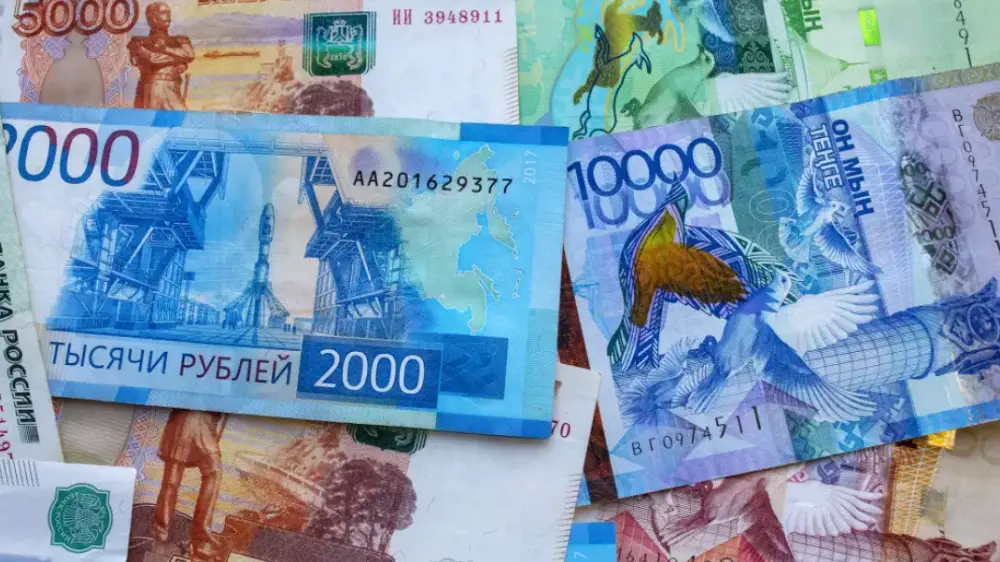
Tengrinews.kz – As oil prices decline and analysts forecast further weakening of the Russian ruble, economists warn that the trend could spill over into Kazakhstan, where the tenge traditionally reacts to movements of its largest trading partner’s currency. Tengrinews.kz spoke with Kazakh experts about how noticeable the impact may be.
Russia’s currency is under active discussion domestically as well. In a recent analysis for RBC, Wealth IQ analytics director Kirill Komarov noted that the ruble appears “overstrengthened”: its current rate does not fully reflect accumulated inflation and puts pressure on the state budget. He suggests that a gradual weakening — stretched over a year or two — is more likely than a sharp, one-time drop.
Oil prices and Russia’s budget squeeze
Media reports say sanctions targeting major Russian oil companies could further weaken the ruble. Economists point primarily to the steep decline in the price of Urals crude — a key source of foreign currency revenue for Russia.
The Russian Finance Ministry reported that in November the average Urals price was $44.87 per barrel. In mid-November, it briefly plunged to $36.61, the lowest since March 2023. Experts say this deprives the Russian budget of vital foreign earnings and increases the risk of ruble depreciation.
Economist Almas Chukin explains that Russian oil still accounts for 10–15% of the global market, making a full blockade unrealistic.
“To limit revenues for a country at war, a price cap was imposed: Russian oil can be bought, but not above $60. Now that threshold has fallen into the 40s,” he said.
According to him, sanctions were expected to shrink supply and push prices up — but the opposite is happening.
“OPEC is ramping up production, and Russia continues to sell cheaper and cheaper. Prices aren’t rising, they’re falling. They’ve slipped to just above 60, though recently they were 80–90,” Chukin noted.
Why a weaker ruble may suit Moscow
Financial analyst Arman Beisembayev says Russian authorities themselves have long favored a softer ruble.
“Industrial groups and policymakers have openly said they want the ruble around 90–100. Right now it’s 75–77 — that’s not enough for them,” he said.
Because discounted oil reduces export revenues, a weaker ruble allows the state to receive more rubles per dollar when converting foreign earnings.
“Everything is being done to create conditions for a smooth downward move in the ruble,” Beisembayev said, adding that it could slide gradually over several months to around 100 per dollar.
Chukin notes that until recently the ruble had strengthened due to an oversupply of foreign currency from exports.
“Russia has excess foreign currency with nowhere to put it, so the ruble strengthened. But that’s bad for the budget,” he said.
Authorities are now trying to reverse the trend and ease the currency lower.
Impact on the tenge
Economists say the tenge almost inevitably reacts to the ruble because of the scale of bilateral trade, Kazakhstan’s high import volume from Russia, and the interconnected market infrastructure.
They also stress that Kazakhstan — like Russia — does not benefit from an excessively strong national currency.
“Kazakhstan doesn’t need a strong tenge — just as Russia doesn’t need a strong ruble. We convert foreign earnings into tenge to fund the budget. The weaker the exchange rate, the more money enters the treasury,” Beisembayev explained.
He noted that the recent strengthening of the tenge toward 500 per dollar was undesirable for fiscal planning.
“Next year’s budget assumes a rate of 540. Our benchmark is roughly 540, ideally 550–560 — that brings in additional billions,” he said.
Because of tight economic ties, he expects Russia’s trend to pass through to Kazakhstan:
“If the ruble is gently guided downward, we’ll move along with it. I don’t expect a panic devaluation, but the ruble’s weakening will be transmitted to us.”
Economist Rasul Rysmambetov, however, warns about the risk of both currencies entering a “race to the bottom,” which could harm producers.
“One ruble now buys 6.5–6.6 tenge. This clearly shows the ruble is overstrengthened. The tenge is returning to its normal levels — the dollar is already at 520–522. The fairy tale of a strong tenge is ending, and it may weaken slightly. But the ruble could weaken much more. This creates a race between the two currencies. Sharp moves in either direction benefit financial players, not producers. Businesses need predictable rates and stable macro conditions,” he said.
What’s next for Kazakhstan
According to experts, the coming months may be shaped largely by Russia’s currency trajectory — especially if the ruble continues to decline. For Kazakhstan, an overly strong tenge is counterproductive, reducing budget revenues and hurting exporters.
At the same time, Rysmambetov notes that intentionally weakening the currency or allowing sharp fluctuations creates uncertainty for businesses and complicates investment planning. Experts therefore argue that Kazakhstan’s main priority should be predictability — keeping the exchange rate stable and avoiding a competitive devaluation cycle with the ruble.

