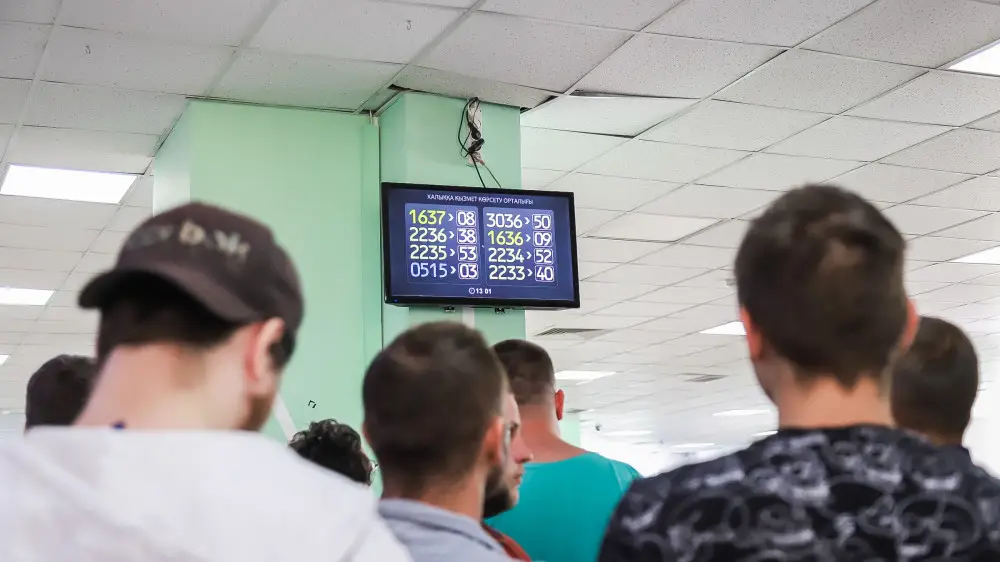
Kazakhstan has tightened its migration rules (currently under a pilot project).
The new restrictions apply to Kandas (ethnic Kazakh returnees), individuals with family ties to the country, and those with no prior connections at all.
Tengrinews correspondent explored what rules Kazakhstan is introducing and why, the specifics of the country's migration processes, current requirements for obtaining a residence permit, and how the changes are being received by newcomers.
Tri-Ministerial Order: Residence Permits in Kazakhstan and KAZTEST
Kazakhstan has established itself as one of the most attractive destinations for relocation in the post-Soviet space. In 2026, the American company Remitly included the country in its Immigration Index, where it ranked 53rd out of 82 nations globally and emerged as a leader among the CIS countries featured in the study. The ranking evaluated several parameters, including quality of life, economic opportunities, and conditions for foreign nationals.
However, this spring, Kazakhstan tightened the requirements for foreign citizens seeking permanent residency. Now, every applicant for a residence permit (VNZH)—a document allowing a foreigner to legally reside in the country for 10 years and enjoy most rights on par with citizens—must:
- Demonstrate proficiency in the Kazakh language: scoring at least 70 percent in each section of KAZTEST, which includes reading, listening, writing, vocabulary, and grammar.
- Possess sufficient funds for living: for five years after receiving a residence permit, individuals must annually provide proof of holding at least 5.7 million tenge (1,320 MCI) in a bank account.
- Reside for at least one year in a state-designated region: the East Kazakhstan, Kostanay, Pavlodar, or North Kazakhstan regions. Major cities like Astana and Almaty are effectively closed to residency applicants.
- Furthermore, applicants must demonstrate high "emigration potential": a solid educational background, work experience, foreign language proficiency, and a high-demand profession.
All these requirements are outlined in a joint order issued by three ministries: the Ministry of Labor and Social Protection of the Population, the Ministry of Internal Affairs, and the Ministry of Artificial Intelligence and Digital Development. For now, the initiative is considered a pilot project; the order will remain in effect until December 31, 2026, after which the rules may be extended.
Tengrinews.kz sent an official inquiry to the Migration Committee of the Ministry of Labor and Social Protection, requesting clarification on several nuances of the new regulations.
In its response, the department noted that the mandatory residency requirement in specific regions does not apply to all applicants..
Exceptions are made for:
- minors;
- investors;
- foreigners with high-demand professions;
- and individuals who make significant contributions to the national economy, participate in priority projects, or possess unique competencies.
For the latter category, a recommendation from the authorized state body is required.
The committee also explained that under the pilot project, an applicant first completes a specialized electronic questionnaire and attaches supporting documents. The system then automatically evaluates their "immigration potential" based on established criteria, assigns scores to the applicant and their family members, and generates a preliminary result used for further review of the application.
Notably, the new rules affect ethnic Kazakh returnees (Kandas) as well as other migrants. During a Mazhilis session in late May, deputies even stated that the requirements could create additional barriers for ethnic Kazakhs, whom the state has for years encouraged to return to their historical homeland. The most significant criticism was directed at the mandatory language test for this category and the restrictions on choosing a region of residence.
"Previously, kandases decided for themselves which region they wanted to move to. But the current pilot project limits their choice. Before this, they didn't have to pass KAZTEST, but now it has been introduced, and our kandases don't even know the Cyrillic alphabet, let alone how to pass KAZTEST. That's why they are currently hovering around the embassies," Murat Abenov noted at the time.
"Kandases need to be exempt from the law"
Former Majilis deputy Murat Abenov, whom we contacted for further comment, notes that the current pilot project to tighten residency permit requirements is being heatedly discussed, primarily in the Kazakh-speaking internet space.
"Since 1991, about 1.6 million kandases have arrived in Kazakhstan. Their children were born here, and their relatives moved over. As a result, several million Kazakhstani citizens are now connected to kandases in one way or another. Therefore, while the Russian-speaking audience might not notice the introduced restrictions, they have caused serious tension in the Kazakh-speaking environment."
He explains this tension as follows: people who have already settled in Kazakhstan are now — due to the tightening of residency rules — unable to bring their relatives here.
"I think the government needs to urgently separate the flows of kandases and other foreigners. If kandases are excluded from the general pool of residency permit applicants, then the new changes are justified, understandable, and effective," Abenov adds.
"Unsure where to go next"
However, the new migration rules have caused concern across various expatriate communities, including the Russian one. According to various estimates, up to 70,000 Russians who moved since 2022 currently live in Kazakhstan. Many of them planned to apply for residency but did not manage to do so in time.
For example, Anzhelika M. moved with her family in 2023. Her eldest child attends a private school in Almaty, and the youngest goes to a private kindergarten. She and her husband also live here on temporary residence permits (TRP) and both work remotely for international companies. They planned to obtain permanent residency to purchase real estate.
"It's very hard for me to accept the fact that we won't be able to stay in Kazakhstan forever. We understand that we likely won't pass the selection for residency. We are ordinary specialists, nothing extraordinary. I worry most about the children now; they don't understand anything yet, and Kazakhstan is the only country they know and love. And we ourselves have grown very accustomed to it over the three years. It will be hard to leave, and it's unclear where to go next," she shares.
"The state is setting a filter"
Experts have been noting since last year that Kazakhstan intended to change its migration policy. In the fall, Kazakhstan tightened the requirements for obtaining student visas. Later, a new Concept for Kazakhstan's Migration Policy until 2030 was approved, which outlines the need to attract highly qualified specialists, regulate migrant resettlement, and protect the domestic labor market.
Commenting on the innovations, Murat Abenov notes that the tightening of rules is intended to:
- strengthen national security,
- protect the domestic labor market,
- create conditions for attracting competitive specialists to Kazakhstan.
Therefore, he considers the requirement of having a certain amount in a bank account justified — it allows for the attraction of foreigners who have sufficient financial resources to live in the country, do not place an additional burden on the social system, and are ready to invest in the economy.
In his view, this helps reduce the risk of linguistic conflicts and facilitates the integration of newcomers. In the context of Kazakhstan, the former deputy notes that a person who has confirmed their knowledge of the state language when obtaining residency will no longer be able to claim they do not understand Kazakh and demand special communication conditions.
Furthermore, according to the former deputy, such a measure will help avoid the formation of closed linguistic enclaves — and for any state, their emergence is associated with additional social risks.
The Ministry of Internal Affairs told the editorial office that the goal of the pilot project is not simply to reduce the number of residency permit applicants, but to change the very approach to applicant selection.
At the same time, the ministry emphasized that the pilot project itself is not linked to any specific changes in the country's migration situation, but is aimed at digitalizing the residency permit application process and implementing an automated system for assessing immigration potential.
However, some experts believe that the real reasons for tightening migrant requirements may be deeper.
"If we are talking about protecting the labor market, there is essentially no one to protect it from: the number of foreigners in the country is negligible — only fourteen thousand officially employed. Such a 'flow' isn't going to take away jobs. In my view, the issue is that this flow has reached a certain stage."

Zhunussova further explains that in migration studies, a period of three to four years is considered the critical timeframe when a visitor's temporary stay most often evolves into a decision to settle permanently.
Kazakhstan experienced a major wave of relocations in 2022–2023. This means the three-to-four-year mark is approaching, after which many arrivals begin to shift their focus from temporary residence to obtaining permanent status.
Kazakhstan itself only recently became a country of net migration growth. While the number of people leaving consistently exceeded those arriving in the past, the situation shifted in 2023: for three consecutive years now, more people have entered the country than have left it.
Nevertheless, those moving for work or other reasons and those choosing Kazakhstan as a permanent home represent different flows with distinct trends. For instance, the number of individuals seeking permanent residency has actually been declining over the last two years.
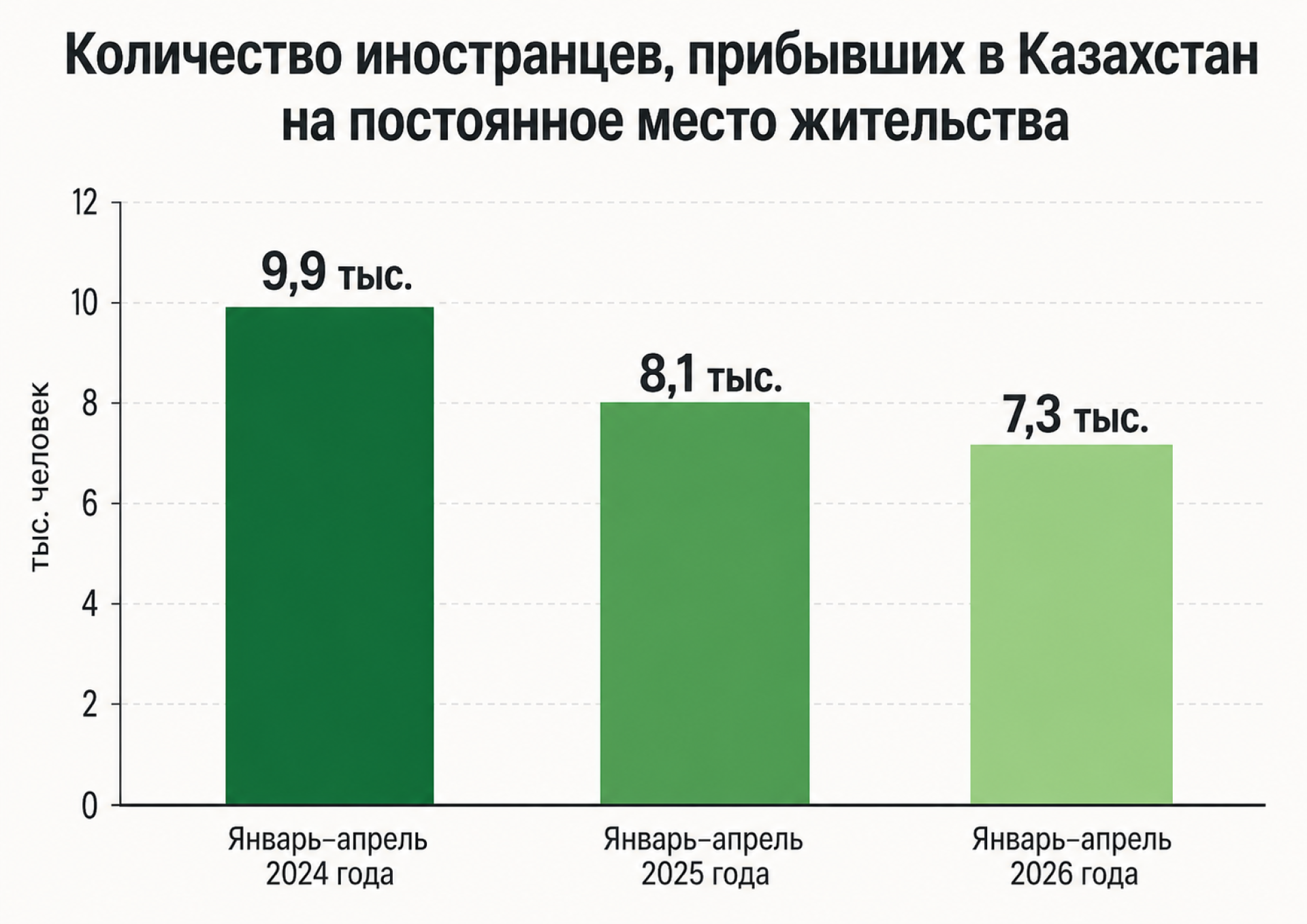 Generated by Tengrinews.kz via AI based on data from the Bureau of National Statistics of the ASPR RK
Kazakhstan Attracts Migrants from Central Asia
Unlike relocants from Russia and Ukraine, migrants from neighboring Central Asian countries have viewed Kazakhstan as an attractive destination for employment and permanent living for many years.
For example, a Tajik citizen who requested anonymity worked here previously — before 2022 — and has since returned. Notably, Kazakhstan is not a foreign land to him: he was born in the Zhezkazgan region, and his mother is ethnically Kazakh.
"Everyone takes me for one of their own, for a Kazakh, but in reality, I haven't been able to obtain a residency permit. I was rejected last year, and I intended to reapply this year but didn't have enough time," our respondent explains.
He explains that it is not the Kazakh language test that frightens him, but the fact that Almaty, where he currently resides, is now closed to new residency permit applicants.
"I don't understand how I'm supposed to live in another region where I have no friends, relatives, or work. I've been in Almaty for several years, and my entire life is centered in this city," he continues.
Meanwhile, our interviewee is a highly qualified specialist: he held leadership positions in international organizations for many years, is fluent in English, and is well-educated. However, these advantages offer little help.
"Right now, I am in Kazakhstan on a temporary residence permit (TRP) — frankly, it's just a one-year registration that only gives you the right to be in the country legally. You don't even qualify for commercial promotions at local banks, let alone more significant matters. For now, I don't know what to do next, but essentially, it's easier for me to leave than to try to stay in Kazakhstan," the man explains.
According to Nodira Abdullaeva, a human rights lawyer and international consultant on migration issues, Kazakhstan is indeed highly attractive to residents of the region.
"Recent statistics from the International Organization for Migration's (IOM) Displacement Tracking Matrix (DTM) on the presence of migrants in Kazakhstan show that about 75 percent of arrivals are from Uzbekistan, followed by Russia, then Tajikistan and Kyrgyzstan. If we look at intentions — who wants to move between countries and who wants to stay in Kazakhstan — Russia is no longer among the primary groups; those wishing to stay are predominantly migrants from Uzbekistan, followed by Tajikistan and Kyrgyzstan."
The expert adds that three main migration routes have formed in Central Asia today.
- Russia remains the primary destination.
- Kazakhstan holds the second spot.
- The third direction involves the diversification of migration flows: regional residents are increasingly heading to Europe, as well as to Asian and Gulf states, for work.
Does Kazakhstan Need Migrants?
Despite the fact that migration has elicited more negative sentiments globally in recent years, host countries generally see more benefits than drawbacks. Abdullaeva explains it as follows:
"The benefits are clear: Kazakhstan fills labor shortages, particularly in seasonal sectors, and the influx of migrants from neighboring countries serves as a form of regional 'soft power.' Regarding the costs, they are linked to the migrants' own status: hiring practices, working conditions, and the dependency of workers in certain sectors, which in turn fuels the growth of the shadow economy."
Former Majilis deputy Murat Abenov expresses a similar viewpoint:
"I am not saying we don't need foreigners. On the contrary, if we want to develop the economy, we must welcome highly educated and competitive specialists who are ready to invest, create jobs, and rent or buy property. Such people are beneficial to the country."
International consultant Abdullayeva also notes that migration from neighboring countries supports the economic foundation. Newcomers fill niches such as construction, trade, and social services. Furthermore, Kazakhstan attracts highly qualified specialists from the region, serving as a destination for business migration. The country needs all of these categories.
"For the third consecutive year, the country has maintained a positive net migration rate. However, if you look at where exactly migrants are going, it turns out we are talking about literally four locations: Astana, Almaty, Shymkent, and the Almaty region. Meanwhile, northern, eastern, and many industrial regions continue to lose population. That is where labor is needed—and we aren't just talking about IT specialists or engineers. Construction, agriculture, and the mining industry largely rely on manual labor. Therefore, Kazakhstan actually needs migration, and it can certainly benefit the country," agrees migration researcher Darina Zhunusova.
But, like Abdullayeva, she points to certain risks:
"Much depends not on whether the state is ready to let migrants in or limit their flow, but on whether it can truly integrate newcomers into society or if it will prefer to limit itself to control and selection."
Is Kazakhstan following a global trend in migration issues?
Experts say that in its attempts to tighten migration policy, Kazakhstan is acting in accordance with a global trend. However, Nodira Abdullayeva makes an important clarification:
"The tightening of migration policy, for example in European countries, primarily concerns the sphere of asylum, border control, and unregulated labor migration. States claim they strive to maintain a balance between protecting human rights, inclusion, economic needs, and security issues. However, in practice, the real needs of migrants themselves are often lost behind the rhetoric of 'regularization' and 'manageability'."
According to her, the European Union serves as a telling example. The EU Migration Pact, which came into force just a month ago on June 12, 2026, expands tools for migration control.
At the same time, organizations such as PICUM or Amnesty International warned that the new rules could lead to the normalization of arbitrary detention of migrants, including families with children, and intensify racial profiling practices.
"The Netherlands, where I live and work, seems like a prime example to me," Nodira Abdullayeva shares. "The country has many problems related to asylum and migration regulation; however, in the field of highly qualified and business migration, it has traditionally offered quite attractive conditions. Now, society is actively discussing and criticizing the fact that the country has chosen a tougher path regarding asylum: abolishing permanent residence permits for refugees, reducing the duration of temporary permits from five years to three, and tightening family reunification rules. In other words, even a relatively open European country is tightening its migration regime today."
The international consultant compares the two and notes that, against this backdrop, Kazakhstan fits into the general logic, but with its own specifics: the state seeks to attract highly qualified specialists while maintaining restrictions for lower-skilled workers.
Added to this is enhanced digital monitoring, stricter requirements for employers, and an expansion of the grounds for refusing or canceling permits.