


 Қазақша
 Русский
 English

ПОДЕЛИТЬСЯ
- Main
- 19 June 2026 20:02
Hands that never tremble
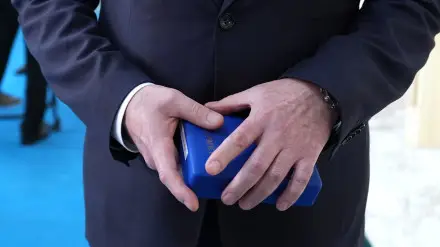 Photo: Tengrinews.kz/Aisultan Kulshmanov
The vessel a surgeon stitches onto a stopped heart is no thicker than a matchstick. Operating on it requires steady hands. On Thursday, June 18, our correspondent Tengrinews.kz observed these hands clasped tightly and still at the Akorda presidential palace.
Hands that cannot afford to fail
The President was honoring medical professionals. Aleksey Kim, a cardiac surgeon from Atyrau, sat alone among the empty gilded chairs. He had flown to Astana the day before, unaware of the award he was to receive.
I asked him what must happen in a person's life to make them want to operate on the heart. He replied that nothing specific had happened:
"It happened spontaneously; I hadn't even thought about it. After university, I was unexpectedly invited to specialize in cardiac surgery. I agreed."
"What qualities must a person possess to become a cardiac surgeon?"
"One must be highly stress-tolerant. Cardiac surgery does not forgive simple mistakes. The heart is stopped and replaced by a machine. If the slightest mistake is made, the patient could suffer a stroke right on the operating table."
The surgeon’s fingers only unclenched when someone else’s hands touched his to guide him or make adjustments.
Aleksey Kim asked to turn off the recorder and requested, if possible, not to be written about. But by that point, he had already become a central figure in this story about hands—a story I couldn't let go.
Gaziza Smagulova, a pharmacologist, explained that it isn't just about the hands.
— "Doctors are hands, heart, and head. You think with your head, support with your heart, and then help with your hands. It is all integrated," Smagulova replied when I asked about the role of hands.
Like Kim, she didn't know which award she was receiving, but she was smiling.
"This award is not just mine. We are a medical family: my parents and husband were doctors, as are my son and daughter-in-law. Everyone is a doctor."
Aleksey Kim’s fingers clasped together once more. He wasn't alone—nearly the entire hall sat in the same posture.
Hands that received applause
When the President entered the hall, the doctors broke into applause. It seemed to me the ovation lasted a bit longer than usual for Akorda. Finally, the clasped hands released.
Tokayev congratulated those gathered on Medical Worker Day, calling medicine one of the noblest professions. The audience responded with applause to nearly every statement.
One statistic stood out: infant mortality in the country has dropped by nearly a quarter over the last three years. The people responsible for this achievement were sitting in that hall.
A new law was also mentioned. Starting this year, anyone who raises a hand against a doctor will face criminal charges.
New hospitals and equipment are only half the battle, Tokayev emphasized, addressing the government. There is still a shortage of doctors, particularly in rural areas.
The President supported the proposal to grant Astana Medical University national status and name it after Toregeldy Sharmanov.
The Karaganda Medical University will be named after Pyotr Pospelov.
The doctors welcomed these announcements with more applause.
Pyotr Pospelov served as the first rector of the Karaganda State Medical Institute from 1950 to 1974. Having arrived in Karaganda in 1933, he was instrumental in organizing the regional health system, led the regional health department, and oversaw evacuation hospitals during World War II. A Candidate of Medical Sciences and Merited Physician of the Kazakh SSR, he is considered a key figure in the development of medical education in the Karaganda region.
Finally, the discussion turned to matters of national pride. The guaranteed volume of free medical care is enshrined in our Constitution, and according to the President, a three-year maternity leave with job security is something not found even in the West.
"I have worked in the West, specifically in Switzerland, and I studied their system. There, in Switzerland and other Western countries, such a system does not exist."
Tokayev then recounted a letter from the Karaganda region. Doctors at a regional hospital had saved a four-year-old child injured in an accident. The family wrote to the President to express their gratitude to the medical staff. This time, the applause was louder than usual.
Hands unaccustomed to accolades
Among the forty-one awardees were luminaries from capital city medical centers, a nurse from a district hospital, and a doctor from a leprosarium. All shared a single citation: "for significant contribution to the development of domestic medicine and diligent work in protecting the public health of the nation."
In the solemn moment, hands accustomed to labor once again found themselves out of place. It was understandable.
Hands reached for pockets, only to freeze halfway.
It was somewhat easier for the women: they were presented with bouquets along with their awards.
Just hands
After the ceremony, their hands found purpose again: journalists, microphones, and a chance to finally examine the awards themselves.
Konstantin Khairov has been operating on children since the nineties. When I asked how he views his hands—his primary tools—he simply shrugged.
"There is no special treatment for them," the pediatric surgeon said.
Yet he held the small blue box containing his order with both hands, cradling it carefully.
"We use them for everything—we drive nails just the same," agreed Azamat Orazalinov, a pediatric surgeon from Astana standing nearby.
"And we shovel snow in the winter if we have to," Khairov added.
He claims no special reverence for his hands. Yet those hands have remained steady in the operating room for thirty-two years and have performed over six thousand surgeries. It is impossible, he says, to count the lives saved.
"To this day, I don't know exactly why, but I chose pediatric surgery. I haven't regretted it for a single day. I enjoy bringing joy to children and their parents."
His youngest patient was only three hours old.
In the adjacent hall, other steady hands held a similar blue box. The "Shapagat" medal was already pinned to Aleksey Kim's chest, but he continued to gaze at the empty case and the award certificate, as if double-checking that it was truly meant for him.
Photo and text by Aisultan Kulshmanov
Editorial Question
What’s your take on this news?
Comments are moderated by the editorial team
Show comments


 +7 (777) 001 44 99


