
Recently, we reported on a nine-month-old child from Kazakhstan who nearly died in Vietnam after swallowing a safety pin.
Unfortunately, such cases are not uncommon in our country either. A Tengrinews.kz correspondent decided to find out which objects young Kazakhstanis most often choke on and which of them pose a deadly threat.
Neonatal surgeon Nurhat Mukhametkaliyev spoke about unusual and frightening cases from his practice, as well as the main mistakes parents make.
Why infants with siblings are at risk
From 2013 to 2021, Mukhametkaliyev worked as an emergency pediatric surgeon in Semey. Over the years, he had to remove all kinds of objects from children’s stomachs and intestines — from ordinary coins to needles, batteries and magnetic beads that nearly cost them their lives.
According to him, foreign objects most often enter the gastrointestinal tract of children under the age of three. At this age, children actively explore the world “by taste,” which is why the risk of swallowing something is especially high.
Less obviously, infants under one year old who have older brothers or sisters are also at risk. The surgeon says they sometimes become unwitting participants in such incidents.
“I remember a case when a five-year-old brother put a small object into an infant’s mouth while playing. Fortunately, everything ended well, but situations like this happen much more often than parents think.”

In older children, such emergencies usually happen accidentally — while laughing, talking or playing, the specialist emphasizes.
What children swallow most often
In most cases, coins with denominations from 10 to 100 tenge are found in the stomachs of young patients. These are considered the most common foreign objects with which children are admitted.
However, doctors also encounter far more dangerous items: button batteries, zipper sliders, needles and pins.
Although many parents fear sharp objects the most, in practice, the pediatric surgeon says, the most life-threatening items are magnets and flat button batteries.
Mukhametkaliyev explains that a battery can cause a severe chemical burn of the esophageal tissue and deep necrosis within just a few hours, and in some cases can lead to disability or even death.
“As for magnetic beads, I have had to operate several times on children who swallowed them. The danger is that magnets can attract each other through the intestinal walls. As a result, perforations, intestinal fistulas, peritonitis and other serious complications can occur,” the doctor shares.
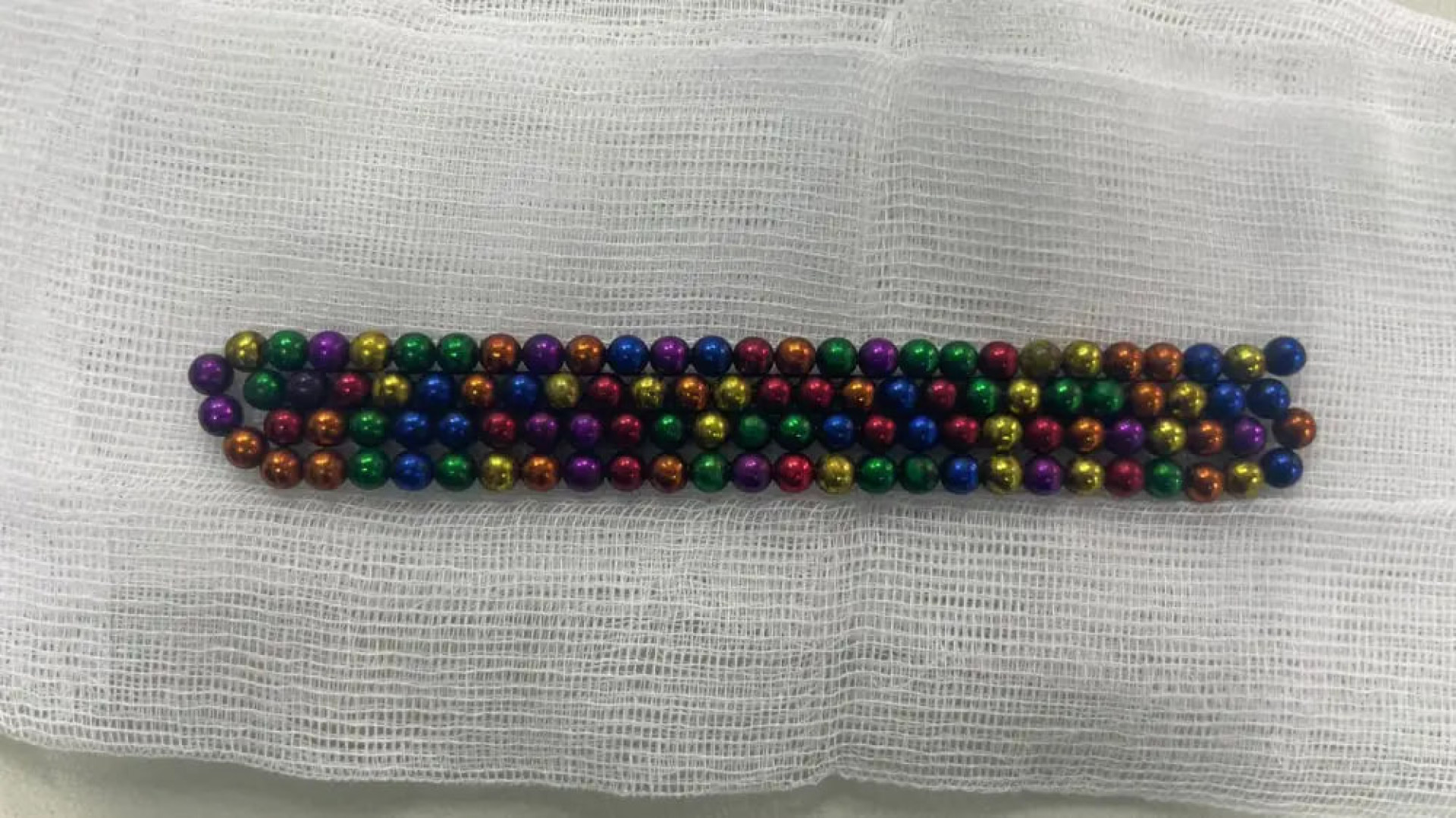 Photo by Almaty Healthcare Department
When it comes to the respiratory tract, sunflower seeds, peanuts and cashews most often get into it. Nuts can block the bronchi, causing acute respiratory failure or complete respiratory arrest, the doctor notes.
What can pass naturally, and what requires immediate surgery?
Nurhat Mukhametkaliyev says everything depends on the type of foreign body and its location:
“If a smooth object has already passed through the esophagus and has no sharp edges, we usually wait for it to pass naturally. Small-diameter coins, zipper sliders and other similar objects usually come out on their own.”
But if a child swallows a battery, it must be removed as quickly as possible. Magnetic beads, meanwhile, often become the reason for emergency surgery.
“Sharp objects also require an individual approach. The treatment strategy depends on their location and whether there are signs of damage to internal organs,” the surgeon says.
Today, however, according to the doctor, open surgery can be avoided in most cases.
Foreign objects are removed from the stomach using gastrointestinal endoscopy, or FGDS, while objects in the respiratory tract are removed by bronchoscopy. Open surgery, or laparotomy, is required only if peritonitis, bleeding or obstruction develops.
A lucky exception and an emergency on bus routes — the surgeon’s stories
The surgeon admits that over the years, there have been many stories that are impossible to forget.
“One of the most surprising cases involved a child who swallowed a sewing needle. Although it is a very dangerous object, the needle passed through the entire gastrointestinal tract on its own and came out naturally without damaging any internal organ. But this is more of a lucky exception than a rule, and parents should not count on such an outcome,” he warns.
Mukhametkaliyev also recalls another incident: a child had an open safety pin in his stomach. During gastrointestinal endoscopy, doctors were able to carefully grasp it by the safe end with special forceps and remove it. Surgery was not needed.
“I also remember another case well. One young patient’s parents worked as bus conductors. The child often rode with them and played with coins that were kept near the driver. But one day, while the bus was moving, it bounced because of an uneven road, and the child accidentally swallowed one of the coins,” the specialist says.
 Photo: Depositphotos.com
According to the expert, such cases have a certain seasonality. They become more frequent in summer, when children spend a lot of time outside and play more actively, as well as during holidays.
“Adults are busy with guests, while children gain access to food and objects that are not intended for their age. Unfortunately, I have seen tragic consequences of aspiration involving nuts. Despite all the efforts of doctors, sometimes, due to prolonged hypoxia, or oxygen deprivation, it is no longer possible to save a child’s brain. These are the cases that remain in the memory of every pediatric surgeon,” Mukhametkaliyev recalls.
“The first minutes determine the outcome”: what not to do if a child swallows an object
Many may remember from childhood the folk method of trying to “push” a stuck object down with food. Nurhat Mukhametkaliyev urges parents to forget such methods for good:
“A very dangerous myth is trying to ‘push’ an object down with bread, a banana, porridge or other dense food. Not only does this not help, but it can also damage the walls of the esophagus, stomach or intestines.”
The expert says parents should also not induce vomiting on their own.
According to him, the best solution is to call an ambulance as quickly as possible. While waiting for it to arrive, parents should use age-appropriate first-aid techniques for choking:
- for infants — alternating back blows between the shoulder blades and chest thrusts;
- for older children — the Heimlich maneuver. To do this, stand behind the person, wrap your arms around their waist, make a fist with one hand and place it just above the navel but below the chest, then grasp the fist with your other hand and make several sharp, strong inward and upward thrusts.
“In my opinion, all parents should know these skills, because they can save a child’s life even before doctors arrive. Sometimes it is the first minutes that determine the outcome,” Nurhat Mukhametkaliyev notes.
The surgeon also says parents should be alerted by symptoms such as:
- difficulty breathing;
- difficulty swallowing;
- excessive drooling;
- severe anxiety;
- vomiting, especially with traces of blood;
- severe abdominal pain;
- blood in the stool.
“It is better to come to the hospital once unnecessarily than to be too late” — doctor’s advice
Nurhat Mukhametkaliyev recommends removing all small objects until a child is at least three years old:
“Especially toys with small parts, magnets and batteries. I would also like to specifically mention plastic construction toy parts. They are often not visible on a regular X-ray, which significantly complicates diagnosis.”
The doctor also says that in families with a small child, older children’s toys should be stored separately. When buying toys, parents should pay attention to their quality and age labeling. According to him, saving money on this can come at too high a cost.
“Fortunately, in my own practice, there have been no cases where parents made the situation worse through their actions. But I have repeatedly seen the consequences of seeking medical help too late in other emergency situations,” the specialist says.
Therefore, he recommends that if there is even the slightest suspicion that a child has swallowed or inhaled a foreign object, parents should not try to solve the problem on their own or waste time on advice from the internet.
“It is better to come to the hospital once unnecessarily than to be too late once. Over the years of my work, I have become convinced that most children can be saved precisely because their parents seek help in time,” Nurhat Mukhametkaliyev adds in conclusion.